Get Full Government Meeting Transcripts, Videos, & Alerts Forever!
Get email alerts on the Legislative Process topic
No spam. Unsubscribe anytime.
Judiciary Committee debates bill to tie register-of-wills pay to state salary schedule; consent calendar passes
Summary
The Judiciary Committee approved a consent calendar but pulled Senate Bill 471 for separate consideration after members raised concerns that the measure could shift control over pay caps for registers of wills and similar offices from the legislature to the Board of Public Works.
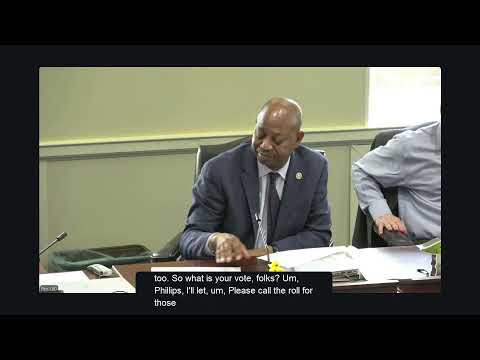
The Judiciary Committee met Wednesday in a vote session and approved a consent calendar (voting list No. 19) with Senate Bill 471 removed for separate consideration. The chair directed a roll-call on the consent calendar and announced that it passed after the clerk recorded a series of 'I' (yes) votes and several excused or absent members.
Members then turned to Senate Bill 471, a measure that would change how the annual pay for registers of wills and certain clerks is set. A motion to report the bill favorably was made and seconded. Leader Moon said he would support the bill but warned it raised larger policy questions: "This is an interesting bill because it replaces us with I think the Board of Public Works as the deciding body on the registers of wills," he said, urging the committee to consider whether pay pegs should be uniform across offices.
Several delegates said the bill’s fiscal note and bracketed figures were unclear. Delegate Arcan said that, when the fiscal note was reviewed on the floor, what looked like a potential saving instead "actually included massive salary increases," prompting members to pull the bill from the consent calendar for separate discussion. Delegates described the current statutory framework as one in which the Board of Public Works sets salaries for these offices while the General Assembly sets a statutory ceiling; the bill would alter how that cap operates.
Delegates debated trade-offs. "I don't think that this automatically increases their salary. It just gives them the opportunity to make more," Delegate Taylor said, arguing that tying pay to statewide steps could let salaries rise automatically with general state salary increases and avoid repeated legislative fixes in heavily populated counties. By contrast, Delegate Simpson emphasized legislative oversight: "We are not giving away our authority," Simpson said, explaining that appropriation decisions and salary schedules remain under the General Assembly’s purview even if the bill changes the mechanism.
Committee members voiced concern that the bill could produce a substantial upward shift in possible pay. Members read aloud figures from the fiscal note saying the current statutory ceiling is about $124,500 and that, with additional fee-based commissions and by tying pay to a grade/step schedule, the effective maximum could rise significantly (members discussed numbers above $146,000 and a theoretical step-20 maximum in the $180,000s). Several delegates recommended a targeted study or expert workload analysis to align pay ranges with county workloads before changing pay-setting authority.
Procedurally, members also addressed how to record absent members' votes for the earlier consent calendar after some delegates asked the clerk to cast votes for colleagues who had been out of the room. After objections were resolved and individual votes read aloud, the clerk recorded the additional 'I' votes and the chair closed the session.
The transcript does not show a final, recorded floor vote on SB 471 in committee during this session; members left open options to hold the bill, seek an Attorney General opinion on precedent and flexibility, or pursue a broader policy review. The committee adjourned with the consent calendar adopted and SB 471 held for further consideration.