Get Full Government Meeting Transcripts, Videos, & Alerts Forever!
Get email alerts on the Public Space Regulation topic
No spam. Unsubscribe anytime.
Council weighs stricter enforcement and vendor support during sidewalk and mobile vending study session
Summary
Staff proposed updates to Redwood City's 40‑year‑old vending code to align with state law and address public safety, sanitation, and equity; council asked staff to prioritize outreach, bilingual education, targeted enforcement, designated vendor sites, and partnership with County Health and small‑business trainers.
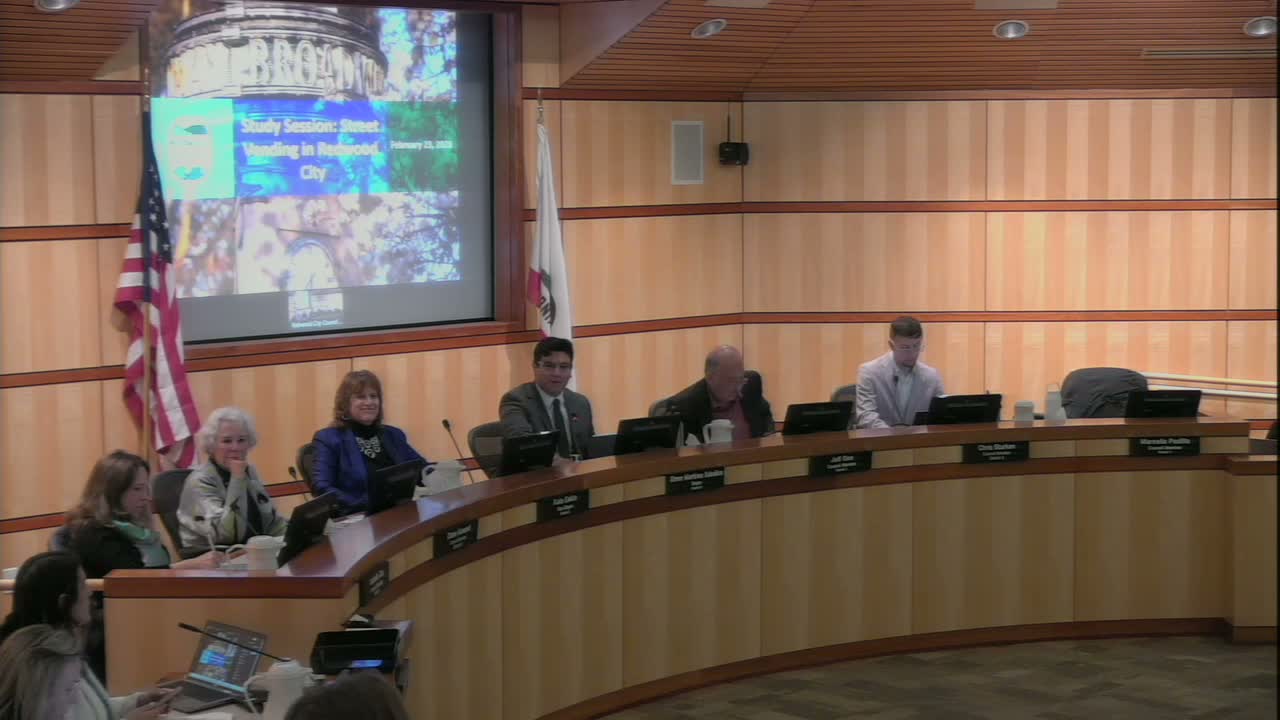
City staff returned Feb. 23 for a study session to outline options for updating Redwood City’s mobile and sidewalk vending rules and to solicit council direction. Deputy City Manager Jennifer Yamaguma and Economic Development Manager Amanda Anthony distinguished motorized vending (food trucks and trailers governed in part by the California Vehicle Code and county health permits) from non‑motorized sidewalk vending (pushcarts, wagons, and stands), and summarized legal constraints, health requirements and enforcement gaps.
Key points from staff: staff said the city’s mobile vending ordinance is nearly 40 years old and must be updated to reflect state law changes that have decriminalized certain sidewalk vending violations and limited local authority over some prohibitions. Staff recommended time, place and manner regulations focused on defensible health and safety criteria: pedestrian and ADA access, traffic safety, hours of operation, and proximity buffers (for example, near school campuses or special‑event areas). San Mateo County Environmental Health staff joined remotely to clarify health permit fee bands for different risk categories: small prepackaged carts (~$439–$489/year) and larger mobile food facility permits (up to about $1,800/year) depending on risk and seating.
Public comment revealed a split: several neighborhood speakers described persistent problems at parks and in residential areas — long‑duration trucks, loud generators, blocked sidewalks, trash and sanitation issues — and asked that the city restrict or better manage vendors near residential blocks and schools. Downtown and small‑business advocates emphasized sidewalk vending’s role in downtown vibrancy and economic mobility and urged support mechanisms (designated spots, micro‑kitchen access, training and outreach) rather than blanket bans. Renaissance Entrepreneurship Center offered to help with vendor training and permitting assistance.
Council direction and likely next steps: councilmembers broadly agreed code updates are overdue and emphasized (1) robust bilingual outreach and education and low‑cost technical assistance to help vendors come into compliance, (2) targeted enforcement and funding for after‑hours bilingual outreach, (3) exploring designated vendor zones or safe parking locations (city right‑of‑way or temporary use permits for private lots), (4) aligning vendor hours with noise/daylighting rules, and (5) specifying defensible health and safety standards (ADA access, trash control, no unsecured open flames where County Health will not permit). Several members asked staff to evaluate differential rules by zone (downtown core vs residential neighborhoods) and to return with a draft ordinance in early summer for council review.
What the city will not do tonight: no ordinance was adopted. Staff said they will broaden vendor outreach, coordinate with San Mateo County Health and the county Office of Labor Standards for worker‑protection information, explore funding for education/outreach, and prepare a defensible draft ordinance and enforcement plan for council consideration in the coming months.