Get Full Government Meeting Transcripts, Videos, & Alerts Forever!
Get email alerts on the Access Model Qa topic
No spam. Unsubscribe anytime.
CMS to open API test environment; vendors must contract with Part B providers and OAP will cover RPM services
Summary
In Q&A, CMS said participants will get a public API test environment later in the spring, vendors should partner via direct contracting with Medicare Part B providers, and RPM is allowed but must be paid from the monthly outcome‑aligned payment (OAP); CMS will publish a participant list on July 1.
During the office hour’s Q&A, CMS co‑leads answered implementer questions about testing, vendor pathways, billing and the participant list.
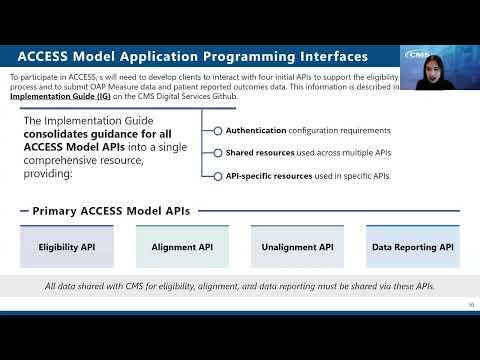
Pooja Nair said an API testing environment will be available to participants later in the spring to support code development and iteration; CMS will onboard participants to that environment and collect emails used for notification subscriptions. "Api testing is going to be a fully open and available to participants later this spring," she said.
Vendor partnerships: CMS advised that technology vendors seeking to participate should do so through direct contracting with a Medicare Part B provider; CMS plans to launch an Access Tools directory but guidance for the directory was described as still forthcoming.
Billing and RPM: CMS confirmed that remote patient monitoring (RPM) is a form of technology‑enabled care supported by the Access Model, but that RPM services would need to be paid for by the monthly outcome‑aligned payment rather than billed separately under fee‑for‑service codes. "Due to the fee‑for‑service exclusion in access, participants may only bill the access G codes for their aligned patients during those patients' active care periods," Nair said.
Participant list and public reporting: CMS said it will publish the initial participant list (names only) around July 1 and later add risk‑adjusted outcome measures and performance data so beneficiaries and providers can compare participating organizations.
Unresolved technical details: attendees asked whether blood pressure values must come from an RPM device or could come from office checks; CMS said blood pressure needs to be a device that can log values and that the team would follow up with precise requirements in writing. CMS also encouraged attendees to consult the implementation guide, RFA, and the forthcoming operations manual for implementation specifics.
What happens next: CMS will publish the implementation guide and operations manual, open the API test environment, and post slides and recording to the Access web page; implementers were directed to the Access model help desk (accessmodelteam@cms.hhs.gov) for follow‑up questions.