Get Full Government Meeting Transcripts, Videos, & Alerts Forever!
Get email alerts on the Housing And Local Codes topic
No spam. Unsubscribe anytime.
San Angelo planning commission advances work on smaller‑lot zoning, LDSO street standards and food‑truck rules
Summary
Commissioners reviewed proposals to add three smaller residential zoning districts and to revise the land‑development code to allow narrower new local streets and clearer sidewalk rules to support affordable housing. They also considered loosening limits on mobile food units and creating rules for food‑truck parks; staff will return with redrafts for joint review with council.
The Planning Commission on March 23 discussed a package of regulations intended to promote infill housing and make development less costly, as well as updates to mobile‑food‑unit rules and the creation of a food‑truck‑park use.
Lead planner Ray Linbury explained a proposal to add three residential districts: RS4 (smaller single‑family lots, 35 ft wide with a 3,000–5,500 sq ft lot area range), RS5 (an infill‑only small‑lot zone) and RS6 (to allow triplexes and quadplexes). Staff proposed removing floor‑area‑ratio (FAR) limits and relying on lot area, setbacks and a maximum height per zone instead. The proposal would not rezone properties automatically; any rezoning would come before planning commission and city council. Staff also proposed recognizing industrialized (modular) housing as an allowed structure type subject to local and state code and a permanent foundation requirement.
Developers and builders who participated on the committee that drafted the text urged clarity on the RS5 infill restriction (some asked it be allowed citywide rather than limited to HUD‑designated infill tracts). Commissioners discussed parking, the practical difference between 15‑foot and 18‑foot driveway setbacks for front entry vs. rear entry homes, and the practical 10% variance authority staff can exercise. Several commissioners and builders asked staff to adjust minimum lot‑area numbers in RS2/RS6 to maintain buildability and to remove any value‑based tests for modular/industrialized units.
Austin Reed presented proposed LDSO (land‑development/subdivision) changes to reduce the required new local street paving width (for new construction) from 40 ft to 36 ft in many cases and to clarify sidewalk triggers: sidewalks would be required within 300 ft of schools and parks measured by the direct path along the roadway from the new development. Staff said many developers seek variances under the current standards, which suggests revisions could reduce upfront costs and encourage infill development.
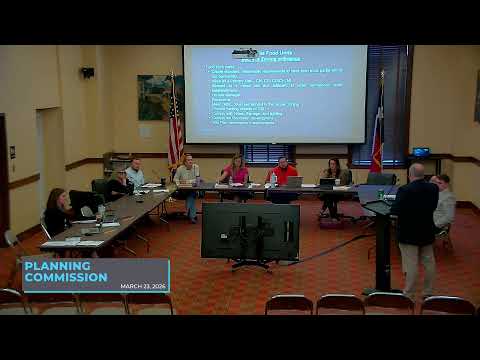
On mobile food units, staff recommended allowing food trucks to operate on private residential property for short events (staff proposed up to three events per property per year, six hours in a 24‑hour period, with noise and lighting requirements), to permit food trucks at parks and school sites with written consent, and to create a new 'food‑truck park' use in suitable commercial/industrial zones subject to parking, restroom and site‑plan standards. Commissioners were broadly supportive and asked staff to draft ordinance language for the joint planning‑council meeting so the issues can be reviewed publicly.
Next steps: staff will prepare revised and clarified draft ordinance language for the new residential zones, LDSO edits and mobile‑food rules, and will post the materials for public review ahead of the next planning‑commission meeting and joint council session.