Get Full Government Meeting Transcripts, Videos, & Alerts Forever!
Get email alerts on the Data Centers topic
No spam. Unsubscribe anytime.
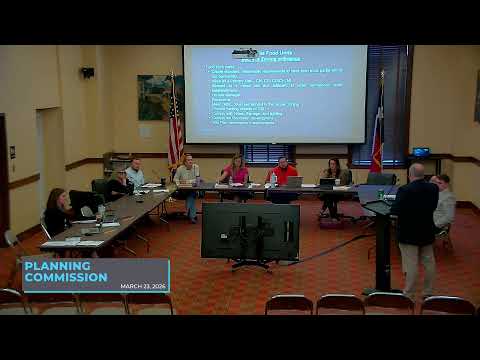
Planning commission tables draft data‑center ordinance after residents press for clearer water, noise and landscaping rules
Summary
After hours of testimony, the San Angelo Planning Commission voted unanimously to table proposed land‑use rules for data centers and asked staff to rework landscaping, buffer/setback language and water‑use provisions before the ordinance goes to council.
The Planning Commission on March 23 tabled a proposed ordinance that would have required data centers to seek conditional‑use approval in light‑ and heavy‑manufacturing zones and to meet new design and environmental standards. The commission voted 6‑0 to send the draft back to staff for revision after sustained public concern about water use, low‑frequency noise and the scale of proposed 300‑foot residential buffers.
Aaron Venoy, director of planning and development services, opened the discussion by saying staff wanted to rescind a prior director’s interpretation that allowed data centers by right and instead place them under a conditional‑use process with explicit design standards. The draft would require pre‑development site plans, noise studies, water‑use studies (including closed‑loop cooling protocols), landscaping, masonry screening for ground‑mounted equipment and building setbacks intended to keep buildings and generators at least 300 feet from adjacent residential zoning in many cases.
Residents and civic speakers told commissioners the draft needed greater transparency and clearer sequencing. Richard Summers (District 5) called for pre‑construction noise, water and lighting studies to be made available before any conditional‑use hearing so commissioners and residents could review technical results in advance. China Young asked staff to require reclaimed water where feasible and to strengthen discharge protections; Vernon Haggler asked whether data centers would provide on‑site generation and how that might affect grid stability and prices. Several commenters urged the city to tighten rules or to make public the consultant studies that informed the draft.
Developers and a staff liaison said many of the draft rules reflect best practices from markets that already host large data centers, but commissioners agreed the ordinance needed revision to be both protective and practical. After discussion the commission directed staff to return with edits focused on three areas: (1) reconsider how the ordinance defines and applies the 300‑foot buffer and align setbacks to a clearly defined building/fall zone, (2) rework landscaping requirements—particularly side and rear buffering versus parkway/frontage treatments—to reduce excessive water demand while preserving design objectives, and (3) clarify water‑use thresholds and the administrative process (including whether additional fees or protocols apply when a closed‑loop system requires recharge or third‑party water). The commission asked staff to prepare revised language and supporting materials for the next return to the commission and eventual council consideration.
The commission’s action preserves the conditional‑use approach but pauses adoption to allow staff and stakeholders to reconcile community concerns about process sequencing, water availability and enforceability before a final ordinance is recommended to council.
Key directives to staff: • Revisit residential adjacency rules and define the building/fall zone approach for setbacks; consider lower numeric buffers where appropriate and justified. • Reexamine landscape prescriptions (item #12 in the draft) to prioritize parkway/frontage standards and drought‑tolerant species while reducing mandatory plant counts that could increase water demand. • Clarify water‑use language (item #16) including thresholds, exceedance protocols, and administrative authority for approvals or denials if potable water supplies are constrained.
Commissioners and staff said they intend to publish the revised draft and technical appendices before the next commission meeting so residents and commissioners can review the changes in advance.