Get Full Government Meeting Transcripts, Videos, & Alerts Forever!
Get email alerts on the Permitting Process topic
No spam. Unsubscribe anytime.
Planning and Building staff explain why permits in Carmel-by-the-Sea can take weeks
Summary
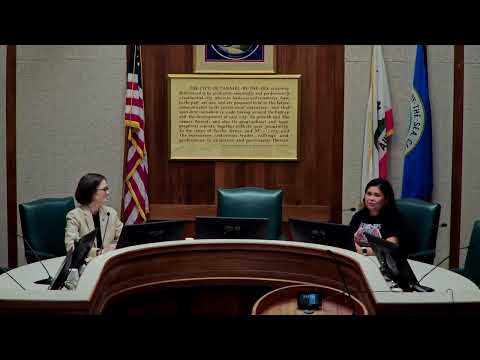
Anna, a Planning and Building staff member, told a community briefing that permit timelines reflect multi‑department reviews — planning, public works, forestry, environmental compliance and sometimes fire — and that the city consolidates comments to avoid repeated rework. She advised residents to review conditions of approval and the department’s online flowcharts.
Anna, a staff member in Carmel-by-the-Sea’s Planning and Building Department, told a Friday community briefing that permit timelines reflect multiple review steps across several city divisions rather than a single‑office delay. “If you look at I would say 99.9% of any jurisdiction … that message that it takes too long … is common,” Anna said, explaining why projects often enter a multi‑step review before construction can begin.
The overview walked residents through the typical sequence: a planning permit process that includes a preliminary site assessment (often by a planner and forester), a design concept stage, and a Planning Commission hearing to review initial designs. Anna said projects then move to a final‑details phase that can include consultant volume studies; because municipal code requirements remain binding, a later volume determination can require further changes even after an approval. “You could have a project that meets floor area coverage and for some reason does not meet volume,” she said, noting that those findings can affect a homeowner’s expectations after investing in a design.
Anna emphasized that planning approvals commonly carry conditions of approval assigning responsibilities to different departments — planning, public works, forestry, environmental compliance and, in some projects, the fire department. Once an applicant submits for a building permit, the package is routed to those same agencies. Anna said staff generally expect department responses within two to three weeks, after which comments are compiled and sent to the applicant as a single, consolidated set. That approach, she said, is intended to reduce iterative rework where an applicant fixes one issue only to receive a late comment on another.
“Look at the conditions of approval,” Anna advised residents. “If you have any questions, reach out to your planner so they can explain that to you so you are aware of what would be coming during the building permit review.” She also noted that the city posts process flowcharts on the Planning and Building website to help applicants follow the stages.
City staff said they are working internally to streamline the process in response to community feedback but acknowledged some delays are inherent to the required multi‑agency reviews and municipal code constraints. There was no formal action taken at the briefing; staff encouraged applicants and property managers to contact the Planning and Building Department with questions and to consult the online resources for detailed flowcharts and timelines.
The session closed with a reminder that site‑specific conditions and municipal code requirements can alter timing, and that applicants should expect consolidated comments after the routed reviews are completed.