Get Full Government Meeting Transcripts, Videos, & Alerts Forever!
Get email alerts on the Licensing Roundup topic
No spam. Unsubscribe anytime.
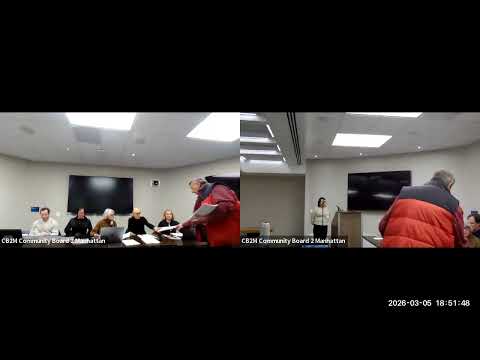
Manhattan City committee reviews multiple liquor-license and open-streets applications; residents press for limits on hours and sound
Summary
The community board heard presentations from several restaurant applicants on hours, soundproofing and basement access, and voted "deny unless" or asked for stipulations on a number of applications; objections concentrated on late hours, sound control and sidewalk/roadway seating.
The Manhattan City Community Board Liquor Licensing Committee spent the meeting hearing a queue of new and transfer applications from neighborhood restaurants and related open-streets requests, focusing attention on hours, access to basements or storage, outdoor seating and soundproofing.
Applicants included AOA LLC (a proposed cafe-and-wine bar at Greenwich Street), a ramen/noodle shop presented by Frank Low, a transfer of Dres license to Amanda Orso (14 Group) at 14th Street, Mitsuro (sushi) and Gastronaut (Slavic-influenced restaurant from Roman Rakusa). Jeffrey's Grocery (an open-streets seating application presented by Gabriel) sought a reduced footprint for Waverly Place open-streets seating (10 tables; 34to 48 seats) and proposed operating ThuSun during the spring-summer season.
Common committee concerns included:
- Hours: Multiple residents objected to late-night closing times. Leslie Clark of the West Village Residents Association urged the committee to oppose additional late-night business hours on strictly residential blocks, opposing a proposed 1 a.m.–2 a.m. schedule for some applicants.
- Soundproofing and noise: For spaces with basements or event rooms, members and neighbors repeatedly pressed applicants to demonstrate soundproofing; neighbors asked for pre-opening sound tests and direct neighborhood contacts for complaints.
- Service and access paths: Committee members probed where food storage and basement access are located and emphasized that food should not be carried through residential hallways.
- Sidewalk/roadway seating and DOT/SLA compliance: Several applicants described DOT permits and the new open-streets configurations; committee members emphasized consistent demarcation to allow community monitoring.
Applicant responses and concessions: The AOA applicant said the space is already partly sound-insulated and plans further door upgrades; the 14 Groups applicant agreed to follow prior Dre stipulations and work with residents on sound; the Gastronaut team offered to reduce or compromise on late-night hours (proposing midnight on certain nights instead of 1 a.m.). Jeffrey's Grocery agreed to operate its open-streets footprint mid-April to early November with hours generally ending at 11 p.m.
Business session outcomes: During the business session the committee recorded "deny unless" recommendations and will circulate stipulations for several applications; a roll-call readout (verbal count) recorded seven committee votes supporting the committee position for at least one open-streets item. The chair said staff will send standard stipulations (hours, no TVs, no host stands in roadbed areas where applicable) to applicants for correction and resubmission to the SLA.
Why it matters: The meeting shows how local liquor-licensing decisions hinge on operational detailshours, soundproofing, exact seating plans and access pointsand how committees use stipulations and monitoring to manage neighborhood impacts. Applicants who cannot meet the committees conditions risk formal "deny" or continued nonapproval at the state liquor authority.
What comes next: The committee will circulate stipulations required for each application and expect applicants to return with clarified diagrams, CO/letter-of-no-objection evidence where necessary, and documented sound tests or mitigation plans.