Get Full Government Meeting Transcripts, Videos, & Alerts Forever!
Get email alerts on the Arts And Humanities Governance topic
No spam. Unsubscribe anytime.
Joint committee backs new Arts and Humanities Council governance, adds equitable grantmaking language
Summary
A Montgomery County joint committee unanimously recommended a bill establishing a 11–15-member Arts and Humanities Council, requiring a racial equity and social-justice grantmaking policy and bylaws ethics provisions; the panel accepted technical corrections and emphasized recusal and oversight procedures.
A Montgomery County joint committee unanimously recommended changes that would establish a county-appointed board for the Arts and Humanities Council and require the council to adopt racial equity and social-justice policies governing grantmaking.
The committee voted to recommend the bill as introduced after accepting technical corrections and a staff-drafted amendment to incorporate an equitable grantmaking process into the AHC’s racial equity policy. Committee leaders said the changes are intended to increase accountability for public funding while maintaining the council’s mission.
Why it matters: The bill would create a board of directors of 11 to 15 members appointed by the county executive and confirmed by the County Council, require a countywide needs assessment every two years, and direct the board to adopt a five-year strategic plan. The Office of Legislative Oversight found a positive racial-equity impact and recommended strengthening the bill’s grantmaking requirements; staff proposed language to embed equitable grantmaking into the AHC’s racial equity policy.
Assistant Chief Administrative Officer Cardona, speaking for the executive branch, told the committee the office had misstated an earlier term in its submission and clarified that the county did not intend to “misappropriate” funds. “We should not have used the word ‘misappropriation’ in our submission,” Cardona said, adding that “misuse” better reflects the county’s view that there was no intentional wrongdoing.
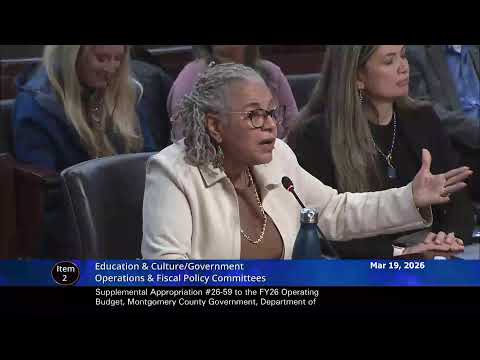
Representatives of the Arts and Humanities Council said the organization has embedded racial-equity principles across its work, noting that the board adopted equity principles in 2018 and that formalizing an equitable grantmaking process would help reach smaller BIPOC artists and organizations. The council’s representative said the proposed changes “serve as a further inc of the work that we’ve done” and expressed support for codifying equity in the policy language.
The governance restructuring prompted detailed discussion about whether ex officio county representatives on the AHC board should be voting or non-voting members. Nonprofit representatives warned that appointing voting county employees risks conflicts and could undermine nonprofit independence, while executive-branch and some council members argued that voting participation ensures accountability that matches the county’s level of investment. Committee members emphasized that recusal requirements and ethics advisory opinions are available to manage conflicts.
Committee Co-chair Stewart and other council members said they lean toward preserving voting rights for ex officio county representatives to maintain public accountability; the executive branch indicated it would accept a compromise of having at least one voting county representative but preferred two for continuity.
Outcome and next steps: The joint committee voted unanimously to recommend the bill (with technical corrections and the equitable-grantmaking amendment) to the full County Council. Committee leaders asked staff and the executive branch to provide additional clarity on recusal procedures and to coordinate onboarding ethics training for the newly constituted board.
The committee’s action does not itself change the county code; it forwards the bill and amendments to the full council for final consideration.