Get Full Government Meeting Transcripts, Videos, & Alerts Forever!
Get email alerts on the Student Discipline topic
No spam. Unsubscribe anytime.
Quincy Middle School credits 'yonder pouches' and advisory checks for sharp drop in phone referrals and fights
Summary
Quincy Middle School told the school board that routine checks of student 'yonder pouches' during daily advisory and other teaching strategies coincided with a drop in cellphone referrals from 136 to 13 and fewer bullying referrals (36 to 14), and students said the policy improved focus and relationships.
Quincy Middle School administrators told the Quincy School District board that a districtwide cellphone-management program and reinforced advisory routines have markedly reduced distractions and conflict.
"Last year we recorded 136 cell phone referrals. This year we had 13," Caitlyn Koulsey, an assistant principal at the middle school, told the board. She said the school added a daily advisory check in which advisory teachers verify each student's yonder pouch and address problems individually, and that communication with families has increased.
Two middle-school students, Maya and Sophia, described the policy from a student perspective. "Not having [my phone] has benefited me by a lot by allowing me to focus in school more and improving my grades," Maya said. Sophia said fighting and bullying "has gone down by a lot," and that students are more present and making friends more easily.
School leaders tied the behavioral gains to broader school-improvement goals. Mr. Ramsey walked the board through targets to close achievement gaps for students with individualized education programs and multilingual learners, and described three classroom strategies intended to raise literacy and engagement: academic-language scripts, marking the text, and intentional focus note-taking.
Officials outlined operational details: students place their phones in a designated yonder pouch at the start of class, advisory teachers check pouches each morning, day loaner pouches are available for students who forget, and an opt-out process exists for students who do not bring phones. Staff said about 30 students had completed opt-out agreements; those students accept different expectations and, in some cases, parents must collect phones if agreements are violated.
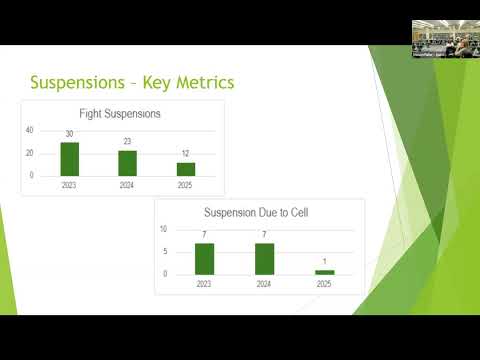
Administrators emphasized the program is not punitive but aims to build routines and strengthen learning. Koulsey said reductions in phone referrals and in-school suspensions for phone incidents (from seven to one in one measure cited) reflect changed classroom climate and increased student engagement.
The presentation closed with board praise for staff and teachers. The board asked follow-up questions about coverage for students who need accommodations; staff said they work individually with those students and that special-education staff support inclusion in grade-level classes.
The board received the report and moved on to the rest of its agenda.