Get Full Government Meeting Transcripts, Videos, & Alerts Forever!
Get email alerts on the Arraignment Calendar topic
No spam. Unsubscribe anytime.
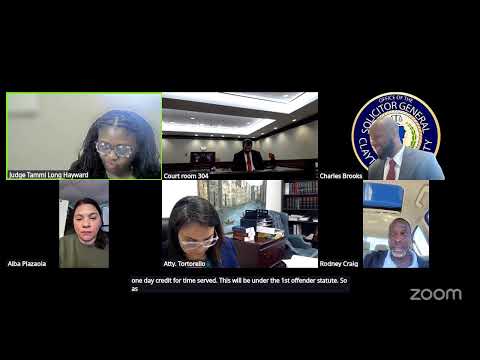
Judge Hayward processes March 12 arraignment calendar in Clayton County State Court; several pleas accepted, some cases dismissed
Summary
At a March 12 arraignment in Clayton County State Court (Courtroom 304), Judge Tammy Long Hayward explained defendants’ rights and resolved numerous cases: several traffic matters were fined or nol prossed, Raquel Paige and Faith Marriott accepted negotiated pleas, Damian Mills pleaded guilty to a reduced speeding charge, and Geron Hajj and Elba Plazuala Mahia received first-offender/family-violence dispositions.
Judge Tammy Long Hayward opened the March 12, 2026 arraignment calendar in Courtroom 304 and walked defendants through plea options, the right to counsel and the consequences of pleas, stressing that self-representation often leaves defendants at a disadvantage.
The judge began by telling attendees that the arraignment “may be the first time that you have seen your case before the trial judge” and reviewed the three plea options: not guilty, guilty and nolo contendere. She repeatedly urged defendants to ensure their Zoom display shows their full first and last name and to use the chat to provide contact information to court-appointed attorneys when needed.
Several matters were resolved on the spot. Taurus A. Williams pleaded guilty to a no-license charge and no contest to a related count; the court imposed a $500 fine on the guilty count (total $737.50 with statutory charges) and granted 60 days to pay. Raquel Michelle Paige entered a negotiated no-contest plea in a school-zone speeding matter; the court accepted a $300 fine (total $444 with charges) and allowed 60 days to pay. Faith Briana Marriott likewise pleaded no contest to several traffic counts, with fines set and a 60‑day payment window.
In a traffic plea that preserved the defendant’s driving record, Damian T. Mills accepted a negotiated reduction (reducing the recorded speed below a points-triggering threshold). The court accepted Mills’s guilty plea to the reduced charge, set the fine at $100 (about $153 with charges) and gave 30 days to pay.
Several misdemeanor and family‑violence cases were also resolved. The court accepted a guilty plea from Geron Hajj to battery (family violence), merging related counts, and ordered a disposition of 12 months with four days to serve (credit for time served) and the balance probated. The sentence included a $300 fine (total about $444 with charges), 40 hours of community service, and enrollment in a 24‑week family‑violence intervention program; the court ordered no violent or harassing contact with the identified victim. Judge Hayward connected Hajj to probation intake and explicitly warned that failing to comply with probation obligations could forfeit First Offender benefits.
Elba Adria Plazuala Mahia entered a guilty plea under the First Offender statute to a family‑violence battery count; the court accepted the disposition, ordered similar programming and community‑service requirements, assessed a $300 fine (total $444 with charges), and made the balance of the sentence suspendable upon successful completion of probationary conditions.
The calendar also included many routine administrative dispositions: several cases were nol prossed (dismissed), numerous bench‑warrant bond forfeitures were noted for absent defendants, and the court appointed Lister/Holton & Dennis (and other listed panel attorneys) to represent indigent defendants where needed. Judge Hayward repeatedly instructed defendants to obtain copies of bond conditions from the clerk’s office and to avoid contact that could violate those conditions.
The judge underscored the practical stakes of probation and first‑offender treatment in a direct admonition to one defendant: “If you don’t find a way to get to probation, you’re going to mess up your one shot at first offender.” In a separate exchange the judge warned a defendant banned from a local retail location, “Anytime you see a Walmart in Clayton County, don’t go.”
The court closed by reviewing the list of dispositions, reminding people how to pay fines (in person at the traffic window or online), and directing defendants with program obligations to contact probation and the clerk for intake paperwork. The session adjourned after the judge summarized outcomes and gave clerks and counsel additional administrative directions.
What’s next: defendants who entered guilty or nolo pleas were given timelines for payments and program enrollment; several defendants were set for future scheduling or were released after conference with counsel. The court encouraged defendants to keep contact information current and to obtain bond‑condition paperwork before leaving the courthouse.