Get Full Government Meeting Transcripts, Videos, & Alerts Forever!
Get email alerts on the Land Use School Expansion topic
No spam. Unsubscribe anytime.
Council adopts PLUM report to allow Marboro School athletic expansion with mitigation and one-year review
Summary
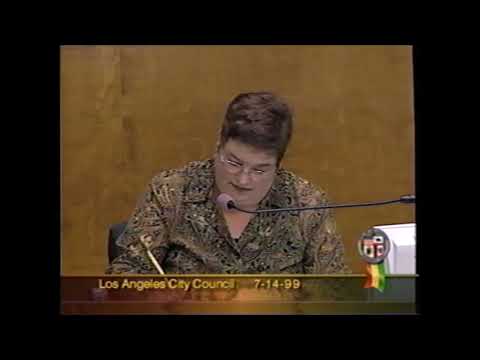
After a lengthy public hearing on July 14, 1999, the Los Angeles City Council adopted the Planning and Land Use Management Committee report to permit Marboro School to expand its athletic facilities with conditions addressing parking, wall heights, gating, noise and a one-year review.
The Los Angeles City Council voted July 14 to adopt the Planning and Land Use Management (PLUM) Committee report approving a conditional use request that will allow Marboro School to expand its athletic facilities in Council District 4, while attaching mitigation measures and a one‑year post‑occupancy review.
PLUM member Miss Makowski recommended adoption, saying the proposal balances neighborhood concerns and citywide needs for recreation: "We need fields. We need places for our kids to have healthy organized activities," she told the council, urging members to approve the committee's controlled conditions and transportation demand management measures.
Opponents — including attorney Jan Chatten Brown and a group of nearby residents — told council members they accept school expansion in principle but asked for stronger mitigation. Brown said she believed key conditions imposed by the city's zoning administrator were removed by the Board of Zoning Appeals and warned that the administrative record did not support some findings: "There is nothing to support that finding," she said, referencing a PLUM finding that a prohibition on amplified sound was infeasible.
Speakers representing affected neighbors pressed for stricter parking requirements. Paul Roberts, representing residents within 500 feet of the site, said the zoning administrator determined the school needed 170 onsite parking spaces and argued that the BZA's compromise left the neighborhood short of mitigation. Roberts said the school plans new bleachers with fixed seating for 170 people yet would have only 136 spaces on site under the BZA decision.
The school and its representatives countered that extensive neighborhood outreach and studies support the project. Mark Armster, representing Marboro School, said the Department of Transportation found no new parking impacts and that the plan increases onsite parking by about 50 percent. Neighbors and neighborhood association representatives offered mixed views at the hearing: some long‑term residents endorsed the PLUM recommendations as a negotiated compromise while others urged reinstatement of specific conditions the zoning administrator had required.
PLUM and staff highlighted several of the conditions that will govern the school's operation if the council's action stands: wall‑height limits that reflect immediate neighbors' preferences (8 or 10 feet depending on locations), restrictions on access gates on Ardan Boulevard except when required for emergency access by the fire department, the establishment of a neighborhood liaison/oversight committee to monitor implementation, major transportation demand management commitments, and a one‑year review after facilities are operating.
The council adopted the PLUM committee report and instructed staff to implement the conditions and the review mechanism. The decision signals the city will allow use of school athletic facilities with negotiated controls intended to address parking, traffic and neighborhood impacts; the one‑year review provides a formal opportunity to revisit conditions if they do not perform as intended.
The hearing record included repeated claims from appellants that approving a mitigated negative declaration and certain findings left the city legally vulnerable; council members and staff said the PLUM report responded to many concerns while preserving the project's recreational benefits. The council proceeded to vote after public comment and committee presentation. The case will be subject to the oversight committee and the scheduled one‑year review once the facilities are in operation.