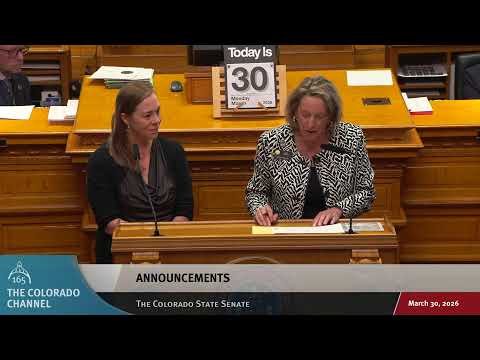
Senate adopts Affordable Home Ownership bill after removing loan component
Summary
Senators passed Senate Bill 40, which adjusts Prop 123 workforce housing rules and AMI calculations; floor amendment L12 removed a proposed short-term loan program so loan details will be addressed separately.
The Senate took up Senate Bill 40 on March 30, advancing changes intended to increase flexibility in workforce home‑ownership funded under Proposition 123. Minority Leader Simpson and Senator Mabrey described committee work that gave the Department of Local Affairs (DOLA) temporary authority for certain short‑term rentals, flexibility on whether local or statewide AMI applies, and an initial construction-bridge loan concept.
At the desk an amendment (L12) was offered and adopted. L12 stripped the loan program component from the bill and clarified waiver language for front‑end ratio (FEL) requests; floor supporters said loan mechanics required more work with DOLA and banking partners and agreed to return with a focused loan proposal later. Minority Leader Simpson said the amendment preserved immediate AMI and affordability fixes while deferring the loan program to avoid delaying passage.
After L12’s adoption, the Senate passed the bill. Sponsors and floor managers characterized the move as a pragmatic step to advance AMI and affordability fixes promptly while continuing negotiations on loan design outside the immediate bill.
The Senate record shows the committee’s amendments and the adoption of L12; the floor action directed no specific implementation timeline beyond existing agency authorities and indicated sponsors will pursue loan program details in future legislation or committee work.
AI generated
The text on this page is AI generated. Summaries, highlights, analysis, and video transcripts are all produced from the original source material.
AI can make mistakes, so if you spot one, and we will fix it for everyone.
Note: the source content is unaltered by us. Any content source we link to, be it a video, an audio recording, or a document, is presented exactly as its publisher released it. That publisher is usually a government body, sometimes an individual official or another organisation.