Get Full Government Meeting Transcripts, Videos, & Alerts Forever!
Get email alerts on the Budget topic
No spam. Unsubscribe anytime.
City manager says collective bargaining contracts widen budget gap; council presses for planning and transparency
Summary
City leaders briefed council on the fiscal impact of recently executed city contracts and pending school agreements, estimating a multi-million-dollar recurring pressure that staff said will contribute to a $2.5 million near-term hole and grow without structural adjustments; councilors urged clearer fiscal analysis and coordination with schools.
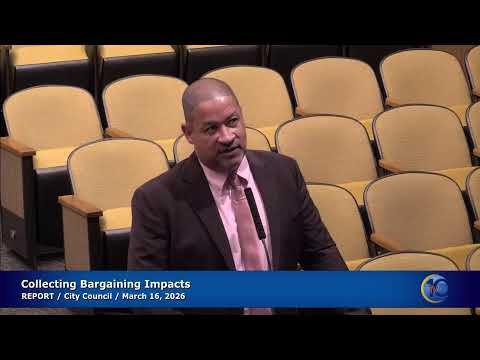
A senior city staff presenter (Sam) told Charlottesville City Council that collective bargaining adopted under the 2021 state law and Charlottesville’s October 2022 ordinance has produced multi-year contracts that will increase the city’s recurring obligations and complicate the FY27 budget.
Sam introduced HR director Joe Gilkerson, labor relations manager Jimmy Moreny and budget director Chrissy Hamill, who together outlined active city contracts (police, fire, transit and labor & trades) and recent school contracts. Staff said the transit contract represents roughly a $4.2 million one-year increase to city operations (increase, not total budget) and that the school contracts and pending professional support agreement could add an estimated $3.5 million annually to the city share of school costs once phased in.
Why it matters: Staff characterized the result as a structural imbalance in ongoing spending. “When you add two big bags labeled collective bargaining contracts, it just gets harder,” Sam said, arguing that the city must weigh trade-offs among priorities and prepare for long-term growth in operating costs. Staff told council the proposed FY27 general fund budget is $279 million and that the recommendation includes a 2% real estate tax increase to help close this year’s shortfall.
Key points in the briefing: staff traced Charlottesville’s path as an early adopter of local bargaining, noted that the state labor board and rules remain in flux, and described the negotiation process (management analysis, mediation, fact-finding and council decisions if an agreement is found unaffordable). They warned of “pay-band hopping” — when negotiated raises in one classification create pressure in neighboring classifications — and said wage-compression and parity between school and city employees are material concerns.
Council reaction and next steps: councilors pressed for earlier and clearer fiscal analysis during school negotiations after staff said the city learned of some school contract impacts only after agreements were reached. Councilors asked staff to provide transparent revenue projections, comparisons of the city’s tax burden and explicit trade-offs (e.g., which major programs or capital projects could be reduced to absorb recurring contract costs). Staff listed upcoming steps in the budget calendar (community budget forum, CIP work session, public hearings) and said council will need to decide whether to raise revenues, cut expenses or use one-time funds to balance the budget.
What remains unresolved: staff emphasized that some numbers (final compensation and comp-and-class outcomes outside signed contracts) remain uncertain and that longer-term solutions will require policy choices about revenue generation and program prioritization.