Get Full Government Meeting Transcripts, Videos, & Alerts Forever!
Get email alerts on the Library Levy topic
No spam. Unsubscribe anytime.
Seattle committee weighs dozens of amendments to 2026 library levy as chair warns of levy-cap trade-offs
Summary
The Select Committee on the Library Levy on March 31 heard public support for added investments and reviewed sponsor amendments that would add tens of millions to the mayor's $410 million proposal; Chair Maritza Rivera said further increases risk shrinking future levy capacity and urged fiscal caution. The committee scheduled a public hearing April 2 and a final vote April 8.
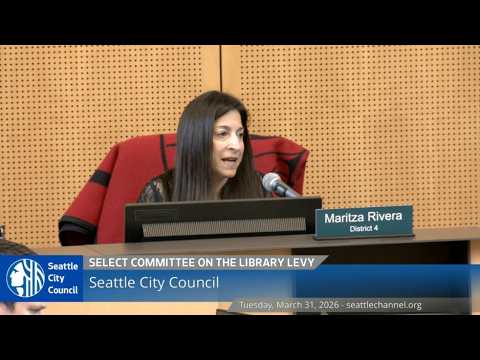
The Select Committee on the Library Levy on March 31 reviewed more than a dozen proposed amendments to the mayor's draft $410 million 2026 library levy, while residents urged the committee to expand collections and programs. Chair Maritza Rivera framed the meeting around the trade-offs of adding funding now, saying the proposed package already exceeds the 2019 levy by 50% and that additional requests could shrink the city's future levy capacity.
"I cannot in good conscience support any additions to this levy," Chair Maritza Rivera said, adding that the foundation's requests would raise the package toward $468 million and reduce future levy capacity. She explained the committee uses a 10% reserve based on historic property-value drops and warned that new additions now would limit the city's ability to fund other priorities in later levy cycles.
Public commenters called on the council to expand collections, multilingual programming and services. "These increases are essential to the library," said Britney, a board member and chair of the Seattle Public Library Foundation's advocacy committee, who cited an additional $70 million requested by advocates that would be spread over seven years. Authors, nonprofit leaders and residents described relying on branch collections, digital services and library programs that serve caregivers, multilingual families and micro-entrepreneurs.
Council sponsors described a range of targeted proposals. Councilmember Foster introduced a $10 million amendment to renovate the Central Library, arguing the building will reach 30 years by the end of the levy term and noting heavy in-person use. Foster also sponsored additions for multilingual play-and-learn programs ($4.5 million) and for four full-time community resource specialists and badge upgrades at the Central branch (about $4 million in sponsor text).
Councilmember Lin proposed a $15 million increase to address deferred maintenance across the system, citing the need to upgrade HVAC and cooling at branches to respond to extreme heat. Councilmember Rinck sponsored a $15 million amendment for a seismic retrofit of a historic Carnegie-era branch and additional proposals to expand e-book and audiobook collections and collection staffing. Councilmember Strauss advanced placeholder-dollar amendments aimed at expanding programming via Seattle Channel, improving ADA accessibility (elevators, escalators), acquiring new physical and digital titles, and contracting safety ambassadors or outreach workers.
Eric, counsel for central staff, clarified that the language presented expresses council intent and that the Library Board ultimately makes allocation decisions: "The way that these are crafted is to show intention, show the increase to the levy, and then show the council intention for how the funds would be authorized," he said.
No formal votes were taken. Committee members asked staff for clarifications on staffing levels and funding sources; for example, staff confirmed the library currently has two community resource specialists (one funded by levy funds). Chair Rivera recessed the meeting briefly to consult clerks about three concept amendments from Councilmember Saka that were not yet in writing; Saka's proposals were read in concept and include technology programs for teens at South Park and High Point, funding for programming with the Washington State Black Legacy Institute, and priority funding for West Seattle branch upgrades.
The committee set a public hearing on the levy for April 2 at 5:30 p.m. and scheduled a final select committee vote on all amendments for April 8 at 9:30 a.m. Chair Rivera said the committee must finalize amendment language promptly to meet August ballot deadlines for an Aug. 4, 2026 election.
Next steps: public hearing April 2, committee vote April 8, and continued staff follow-up on specific cost and allocation questions raised during the meeting.