Get email alerts on the Solid Waste topic
No spam. Unsubscribe anytime.
Dunedin commission approves solid-waste rate increase, ties future adjustments to CPI
Summary
After a detailed staff presentation and public comment, the Dunedin City Commission unanimously approved Ordinance 26-01 to raise residential solid-waste collection rates starting April 1, 2026 and index future adjustments to CPI. Staff said the increases restore reserves depleted by tipping‑fee hikes and inflation.
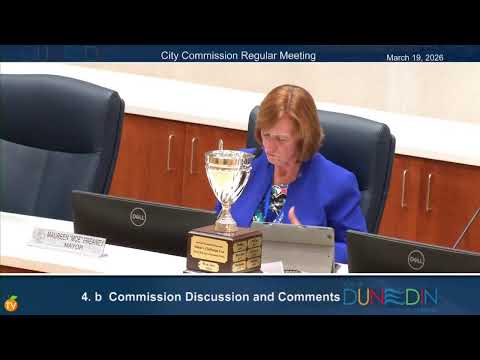
The Dunedin City Commission voted unanimously March 19 to adopt Ordinance 26-01, which raises the city’s solid-waste collection rates effective April 1, 2026 and links subsequent annual adjustments to the U.S. garbage-and-recycling CPI.
City staff and the consultant said the revision is intended to bring user fees closer to cost of service after several years of inflation and higher county disposal charges. ‘‘The recommendation is to fund operating expenses, vehicle lease payments and capital investment and to minimize rate shock going forward,’’ consultant Terry Milbury said during the public hearing.
Sue Bartlett, the city’s public works director, told commissioners the proposed schedule spreads initial increases so the short‑term impact is eased and then uses a CPI floor to keep rates aligned with ongoing costs. For a typical single‑family residential customer, staff presented a monthly charge rising to $30.42 on April 1, 2026, with an estimated $35.17 for FY27 and automatic annual CPI or 3% adjustments thereafter (the ordinance specifies the exact CPI index and calculation method).
Opponents and residents at the hearing said the increases were painful and asked whether delayed planning or budgeting lapses forced sudden hikes. ‘‘Residents are being asked to absorb the consequences of delayed financial planning,’’ resident Julie Nelson told the commission, citing combined increases across utilities and waste that she said strain seniors and single households. Staff answered repeatedly that sharp, pandemic-era inflation, unexpected tipping‑fee increases from the county and higher vehicle and labor costs outpaced prior forecasts and prompted the study.
Commissioners pressed staff on alternatives, including pay‑as‑you‑throw or neighborhood drop‑offs, and on operational efficiencies. Bartlett and Solid‑Waste Superintendent Bill Pickrim described a recent efficiency study and operational changes — including selling surplus vehicles, contracting unincorporated routes and eliminating vacant positions — that reduced costs and were incorporated into the rate model. Milbury said those steps, combined with the rate changes, are meant to stabilize the utility and avoid larger one‑time adjustments in the future.
The ordinance was approved by roll call vote with all commissioners voting in favor. Staff said they will return with a review in three years and will monitor the fund annually and bring adjustments earlier if circumstances change.
What happens next: the ordinance takes effect as written; the city will implement the April 1 change and codify the ratetable (Exhibit A of the ordinance). The commission also asked staff to continue evaluating recycling, curbside-diversion pilots and other options to reduce household bills.
AI generated
The text on this page is AI generated. Summaries, highlights, analysis, and video transcripts are all produced from the original source material.
AI can make mistakes, so if you spot one, and we will fix it for everyone.
Note: the source content is unaltered by us. Any content source we link to, be it a video, an audio recording, or a document, is presented exactly as its publisher released it. That publisher is usually a government body, sometimes an individual official or another organisation.