Get Full Government Meeting Transcripts, Videos, & Alerts Forever!
Get email alerts on the Federal Budget topic
No spam. Unsubscribe anytime.
Arrington urges Article V convention to force fiscal restraints as debt warnings mount
Summary
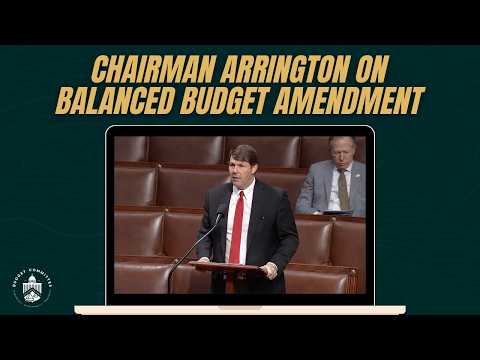
Mr. Arrington told the House Budget Committee that both parties and the institution have failed to control federal spending and urged states to pursue an Article V constitutional convention to impose binding fiscal limits, citing rising debt and a CBO projection.
Mr. Arrington used his allotted time before the House Committee on the Budget to warn that ‘‘we have failed our country’’ on fiscal policy and to press for a constitutional amendment that would force federal fiscal restraint.
Arrington said the nation’s debt picture is dire and argued that Congress lacks the political will to rein in spending. He cited debt-to-GDP levels compared to World War II, an annual deficit he described as larger than combined defense and non-defense discretionary spending, and a Congressional Budget Office projection he summarized as adding vastly to the national debt over the next 30 years. ‘‘If that’s not unacceptable to everybody, I don’t know what is,’’ he said.
The lawmaker framed a constitutional amendment as a ‘‘forcing mechanism’’ to compel the federal government to adopt the kinds of fiscal disciplines state and local governments use. He pointed attendees to Article V of the Constitution as an alternative path if the chamber cannot secure a majority vote on measures he supports.
Arrington also recalled earlier state-driven efforts in the late 1970s and early 1980s to invoke Article V for fiscal limits and urged renewed action from the states to ‘‘restore fiscal sanity’’ in the capital.
The remarks were largely declarative and did not present a specific draft amendment or a motion before the committee. No vote or formal committee action on an amendment was recorded in the session.