Get Full Government Meeting Transcripts, Videos, & Alerts Forever!
Get email alerts on the Federal Budget Deficit Policy topic
No spam. Unsubscribe anytime.
Chair urges adopting deficit-to-GDP measure, a 3% ten-year glide path
Summary
The committee chair opened a House Committee on the Budget hearing arguing for replacing nominal-dollar measures with deficit-to-GDP and urged a bipartisan goal of reducing deficits to 3% of GDP within 10 years; witnesses were introduced for testimony.
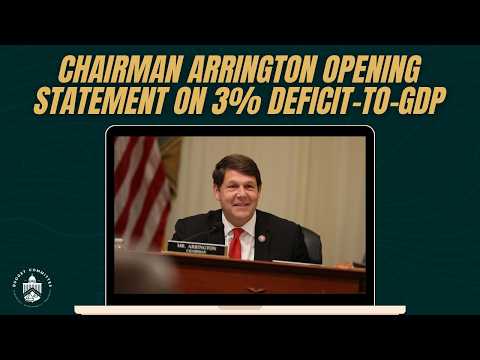
The chair of the hearing convened the House Committee on the Budget and opened a discussion on whether deficit-to-GDP is the most meaningful measure of the nation’s fiscal health, urging the committee to adopt a glide path that would bring deficits to 3% of GDP within 10 years.
The chair said the committee needs "to live in reality" and described deficit-to-GDP (and debt-to-GDP measures) as superior to nominal-dollar savings targets. He argued that the recent practice of setting 10-year balance goals is often politically impractical and can discourage action when targets become unattainable. "When you set goals beyond stretch and into...impractical and unachievable, you give people an excuse to do nothing," he said.
Noting historical comparisons, the chair said the savings required to balance the budget in 2017 was about $6 trillion and that the current figure is roughly $16 trillion, a contrast he used to argue for a more attainable metric. He proposed a 3% deficit target over a decade, saying the goal has been endorsed by a range of financial figures and public leaders and could provide a common framework for both parties.
The chair also referenced commentary from credit-rating agencies, saying their public explanations when downgrades occur typically emphasize the need for a long-term plan and bipartisan commitment to fiscal sustainability. He added that testimony given at a confirmation hearing for "Scott Bessent" had mentioned the 3% objective and suggested that reaching such a target would lower deficits relative to the long-run average and create fiscal space to weather shocks such as another pandemic or major conflict.
The chair introduced the witnesses scheduled to testify: Jonathan Brooks, executive vice president for economic and health policy at the Bipartisan Policy Center; Mr. Burks (identified in the introduction by his prior senior staff roles); Kurt Kautzman, senior fellow for fiscal policy at Americans for Prosperity; Maya MacGuineas, president of the Committee for a Responsible Federal Budget; and Jared Bernstein, former chair of the Council of Economic Advisers (2023–2025). He then yielded the floor to the panel.
The hearing record shows the committee agreed, by unanimous consent, to permit Rep. Bill Huizenga to participate in the session; no formal roll-call vote was recorded in the opening remarks. The hearing moved next into witness testimony and questioning.