Get Full Government Meeting Transcripts, Videos, & Alerts Forever!
Get email alerts on the Environmental Equity topic
No spam. Unsubscribe anytime.
EEC votes to partner with Environmental Equity Investigation to track recommendations
Summary
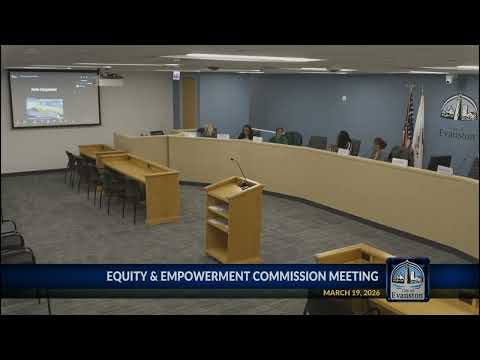
At its March 19, 2026 meeting, the Evanston Equity and Empowerment Commission voted to partner with the Environmental Equity Investigation (EEI) to operationalize recommendations and track progress on environmental equity in priority wards.
At its March 19 meeting, the Evanston Equity and Empowerment Commission voted to partner with the Environmental Equity Investigation (EEI) to operationalize EEI recommendations and track progress on environmental equity in the city.
The motion, moved from the floor by Council Member Harris and seconded during the meeting, passed by voice vote. Commissioners identified four priority areas that EEI had raised — open space/parks and trees; housing and development; streets and transportation; and community services — and asked staff to help monitor how recommendations are implemented.
The commission said the partnership would allow it to request progress reports from staff and to collaborate on data and analysis to identify which communities face environmental disparities. One speaker summarized the commission's anticipated role: the EEC would ask staff for reports, attend relevant meetings, and help ensure recommendations are operationalized within a roughly 90–120 day timeline to begin tracking progress.
Council Member Harris, who moved the motion, noted the EEI presentation had been placed on file by city council and singled out the waste transfer station in the second ward as a high-priority site for equity review. "We are committed to that," Harris said, urging the commission to work with EEI "to see what makes sense for us to galvanize and push our energies towards." (Speaker names and roles are as recorded in the meeting transcript.)
Commissioners also confirmed memos from EEI were included in the meeting packet and that staff contacts (identified in the discussion as Jerry and Janet) would be points of contact for coordination. The commission did not set a formal deadline beyond the 90–120 day planning window but agreed staff would return with progress and that commissioners should be prepared to participate in council or committee presentations when EEI reports are discussed.
Next steps: staff will help coordinate the partnership and provide status reports; the commission will follow up at upcoming meetings and during council presentations where EEI materials are discussed.