Get Full Government Meeting Transcripts, Videos, & Alerts Forever!
Get email alerts on the Professional Licensing topic
No spam. Unsubscribe anytime.
Utah DOPL details licensure pathways for internationally trained mental health professionals
Summary
The Utah Division of Professional Licensing outlined how internationally trained candidates can qualify for behavioral health, counseling, social work and psychology licenses, explaining three license groups, credential‑evaluation routes and supervised‑experience requirements, and providing contact resources.
Shmira Mored, a member of the Utah Division of Professional Licensing’s international credentialing team, outlined steps for internationally trained mental health professionals to pursue licensure in Utah during a recorded webinar. “We are going to talk about opportunities and pathways for internationally trained mental health professionals in Utah,” Mored said at the start of the presentation.
Why it matters: Licensing determines who may legally practice and supervise in regulated mental‑health roles. Mored framed the session as a practical guide to demonstrate education, satisfy credential evaluators and meet supervised‑experience requirements so internationally trained practitioners can continue their careers in the state.
DOPL divides regulated mental‑health occupations into three groups. Nonclinical supportive roles — such as behavioral health technician, behavioral health coach and social service worker — provide administrative support, nonclinical assessments and case management but “are prohibited from engaging in the practice of mental health therapy,” Mored said. Education minimums for those roles were listed as: associate degree or higher for behavioral health technicians, a bachelor’s degree or higher for behavioral health coaches, and a bachelor’s degree in social work for social service workers.
A second group includes clinical licenses that require supervision (for example, certified social worker, associate clinical mental health counselor and certified psychology resident). Applicants for these supervised positions must hold graduate degrees (master’s or doctoral) appropriate to the profession and complete supervised experience hours before applying for full, independent licensure.
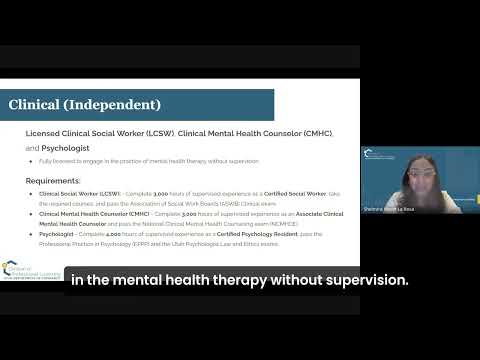
The third group covers independent clinical licenses — licensed clinical social worker, clinical mental health counselor and psychologist — which do not require supervision for practice and allow licensees to supervise others. Mored described the supervised‑experience thresholds DOPL uses: 3,000 hours for clinical social workers and clinical mental health counselors, and 4,000 hours for psychologists, along with required national or state exams.
Mored explained how internationally trained applicants demonstrate educational equivalency. For certain licenses (behavioral health technician, behavioral health coach, social service worker, associate clinical mental health counselor and certified psychology resident), DOPL requires a credential evaluation by a DOPL‑approved evaluator; the presentation named the group referenced as the “National Association of Evaluation Services.” For the certified social worker license, she said applicants must use an evaluation from the Council on Social Work Education or the Canadian Association of Schools of Social Work.
The application process has two phases. In a pre‑application phase, applicants should contact DOPL’s international credentialing team, select the appropriate evaluator and assemble evaluation reports and supporting materials such as course descriptions or syllabi. In the formal phase, applicants submit an online or in‑person application, pay fees, complete any required background checks, show proof of identity and lawful presence, and in some clinical cases appear before the licensing board for review of qualifications.
For follow up, Mored provided an international applicant email contact and pointed viewers to the DOPL website and a web contact form (QR code in the presentation) to submit name, country of origin and the profession pursued for individualized guidance. “We’ll be more than happy to review your case individually,” she said.
The webinar closed with an invitation to contact the international credentialing team for help completing evaluations or applications; no formal policy changes or board actions were taken during the presentation.