Get Full Government Meeting Transcripts, Videos, & Alerts Forever!
Get email alerts on the Data Submission Guide topic
No spam. Unsubscribe anytime.
OKA refines 2026 data submission guide, sets payer timeline for registration and data collection
Summary
OKA presented clarifications to DSG 3.0 for alternative payment model and primary care reporting, added a behavioral health addendum, and set a regulatory and data-collection calendar: publication in April, payer registration in May, test files in June, data collection opens in July, data due early September; annual report expected summer 2027.
Margaretta Brandt, assistant deputy director for health system performance at OKA, told the Investment and Payment Work Group that OKA will publish revised regulations and Data Submission Guide (DSG 3.0) in April and open payer registration in May, followed by a June test-file window, a July start to data collection for the 2024–25 reporting years and a data due date on the first business day of September. OKA plans payer preview meetings from November through January 2027 and to publish an annual report in summer 2027.
The revisions keep the core methodologies for alternative payment model (APM) and primary care reporting unchanged but add detailed clarifications and tools meant to improve submitter accuracy. For the APM file OKA added a step-by-step process map and more explicit guidance on attributing member months. "The methodology has not changed; these are clarifying revisions to help data submitters understand instructions and improve the process," Brandt said.
For the primary care file OKA clarified how to attribute non-claims payments (practice transformation, capitation) and specified that claims-based primary care spending must be reported at the claim-line level rather than at the claim level. OKA also moved the primary care code list into a standalone addendum and added an additional physician-assistant taxonomy code plus new advanced primary care management service codes recently released by CMS.
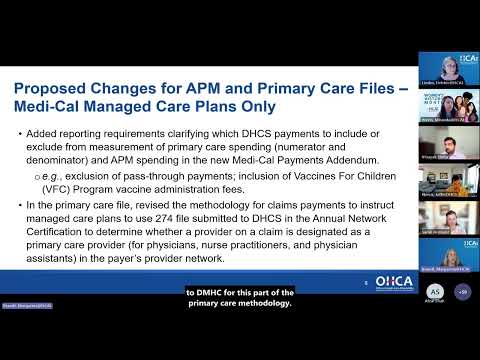
OKA worked with the California Department of Health Care Services (DHCS) to add a medical-payments addendum that clarifies which DHCS payments to include or exclude in primary care and APM measurements. As examples cited by OKA, pass-through payments will be excluded from APM/primary-care measures while vaccine administration fees from the Vaccines for Children program will be included in primary care spending; the cost of vaccine doses themselves will not be counted in the numerator. Brandt said the DHCS coordination is intended to make reporting consistent across medical managed care plans.
The revisions also specify that medical managed care plans should use the January DHCS 274 monthly file for determining whether rendering providers listed on claim lines should be designated as primary care providers for attribution. OKA retained a step in the methodology that maps providers to DHCS or DMHC network files to reduce misclassification of clinicians who share taxonomy codes but do not practice primary care.
Participants raised operational questions during the meeting. One work group member asked whether removing earlier exclusions for non-emergency medical transportation (NEMT) and non-medical transportation would disproportionately change denominators across lines of business; an OKA presenter said the revisions were made after stakeholder feedback and that further discussions with plans and DHCS will continue. New work group member Alcha, CFO at LA Health Plan, said he looked forward to engaging with OKA on implementation details.
OKA will review public comments and responses with the OKA board later this month and then submit the regulations and DSG to the Office of Administrative Law for finalization. The work group will receive additional previews and technical assistance sessions are planned to support submitters during testing and early submission windows.