Get Full Government Meeting Transcripts, Videos, & Alerts Forever!
Get email alerts on the Energy Production Policy topic
No spam. Unsubscribe anytime.
Energy Secretary Chris Wright urges 'massively more' U.S. energy production, highlights LNG, nuclear and grid resilience
Summary
Secretary of Energy Chris Wright told a Sarah Week audience the administration is boosting U.S. energy output—citing expanded LNG permits, keeping 17 GW of coal online during extreme cold and targets for advanced nuclear—as essential to lower costs, reshore industry and bolster national security.
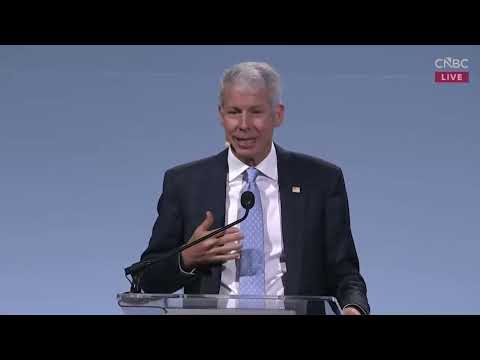
Chris Wright, the 17th U.S. Secretary of Energy, used a Sarah Week keynote to argue that expanding American energy production is essential to lower costs, revive energy-intensive manufacturing and strengthen national security.
Wright framed the administration’s approach as restoring "honesty and candor" to energy debates and said, "Energy is life and the world needs massively more of it." He said the government ended a prior pause on liquefied natural gas permitting and that "over 18 BCF a day of new permits" were approved in the last 13 months, a pace he said could make the United States the world’s largest natural-gas exporter.
Arguing for the role of dispatchable fuels during peaks, Wright described a late-January cold spell that, he said, triggered a record one-week drawdown of 360 billion cubic feet from storage. He told the audience the Department of Energy used authorities to stop premature retirement of about 17 gigawatts of coal capacity that had been slated to close, saying keeping that capacity online helped avert widespread blackouts during the storm. "When electricity demand rises high, supply must meet demand or people die," Wright said.
Wright provided comparative generation figures for the peak week he described: natural gas generation up 47% year-over-year, coal up 24%, nuclear flat and wind generation down about 40%. Using New England as an example, he said wind, solar and batteries combined provided roughly 2% of electricity at an evening peak, stressing that the ability to deliver at peak demand—not total nameplate capacity—is what enables a region to add data centers or manufacturing.
The secretary also highlighted nuclear energy as a central priority. He repeated an administration goal to have three next-generation reactors producing process heat by July 4, saying they "look to be on track" and noting they will not be selling electricity into the grid immediately. Wright described parallel efforts on domestic uranium enrichment, fuel fabrication, reprocessing and a proposed competitive state-level opt-in process for permanent waste disposal sites.
On international coordination, Wright said candid dialogue within the International Energy Agency led to agreement on an emergency release of petroleum stockpiles—"400 million barrels," he said—aimed at easing supply to Asian refineries. He framed energy trade and infrastructure as instruments that typically "create commerce, not conflict," while noting exceptions in geopolitical behavior by states such as Iran.
Wright closed by urging energy policy grounded in "humans and math," emphasizing expanded access and affordability worldwide and highlighting support for reliable energy and clean cooking fuels in Africa. He summed his guidance with two points: "Energy is life and the world needs massively more energy," and that "the modern world is energized by and made of hydrocarbons." The speech concluded with applause.