Get Full Government Meeting Transcripts, Videos, & Alerts Forever!
Get email alerts on the Energy Policy topic
No spam. Unsubscribe anytime.
Energy Secretary Chris Wright says U.S. output cushions markets; prices could fall if Strait reopens
Summary
Energy Secretary Chris Wright told a CERA Week interview that oil prices "would go down quite a bit" if the Strait of Hormuz reopens, credited U.S. production for market resilience, and cited an IAEA report of regional infrastructure damage amid the Iran war.
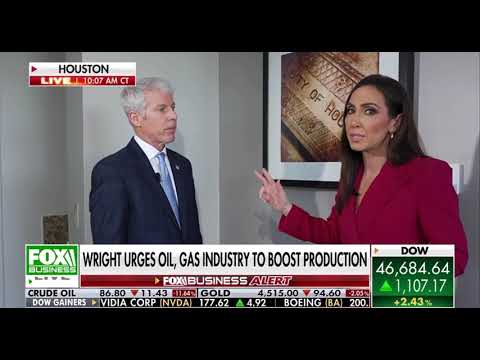
Energy Secretary Chris Wright said U.S. oil and gas production has the market in a strong position and that prices "would go down quite a bit" if the Strait of Hormuz reopens, in a live interview from CERA Week in Houston.
Wright, introduced on-air by reporter Lauren Simonetti, said the United States entered the conflict "in a strong position" and credited "President Trump's policies" for record highs in U.S. oil and natural gas production and robust alliances with other producers.
Asked whether the Strait of Hormuz could be reopened in about five days, Wright said a diplomatic peace agreement could produce that outcome but framed it as contingent on Iran deciding a deal "gets the ends we need." He also said recent military operations "have rapidly destroyed their arm their navy, their air force," describing that as part of the pathway to a deal.
Simonetti and Wright cited market reactions to the possibility of a deal; the reporter noted a national gasoline price of $3.95 a gallon at the time of the interview. Wright also referenced a recent IAEA statement, saying the agency reported that roughly nine nations had about 40 assets with "extensive damage," a factor he said would inflict cost and repair time on the region.
Wright characterized the tension as a long-term strategic problem, saying the United States should not "kick the can down the road" to avoid a future with what he described as a nuclear-armed Iran and a larger missile arsenal. He framed short-term price disruptions as an acceptable cost to prevent a longer-term threat to global energy security.
The interview concluded after roughly the on-camera exchange; the broadcast returned to the studio anchor.