Get Full Government Meeting Transcripts, Videos, & Alerts Forever!
Get email alerts on the Zoning Ordinance Rewrite topic
No spam. Unsubscribe anytime.
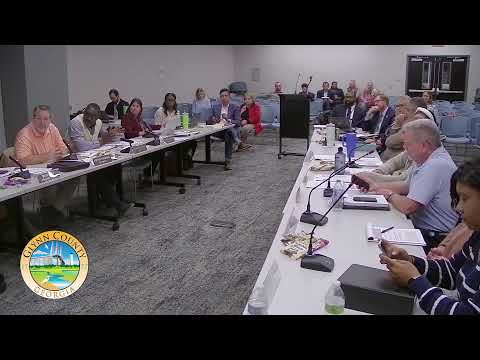
Glynn County planning commission forwards major zoning rewrite with targeted amendments and follow‑ups
Summary
After a staff presentation and three hours of public comment, the Glynn County Planning Commission voted to forward a comprehensive zoning ordinance rewrite to the Board of Commissioners with multiple amendments and requests for additional study, including a 120‑day review period for newly proposed data‑center rules and a work group on beachfront lighting.
Planning staff presented a comprehensive rewrite of Glynn County’s zoning ordinance and related subdivision regulations and the Planning Commission voted to forward the draft to the Board of Commissioners with a series of targeted amendments and follow‑up tasks.
The commission’s review covered changes to definitions, new district maps, updated development standards and administrative procedures, a proposed July 1, 2026 effective date, and several substantive topics—remote parking allowances, exterior lighting rules, accessory‑dwelling‑unit (ADU) definitions, buffers for wetlands and marshes, and a new special‑use pathway for data centers. Staff emphasized that several numeric thresholds remain to be finalized in later steps; "we are looking at the same three‑month timeframe for adoption," staff said during the presentation (Staff (presenter), SEG 080–085).
Why it matters: the rewrite changes how the county regulates new development and certain uses. Public commentators warned that the draft, as written, could increase density in established neighborhoods, leave existing beachfront lighting violations unaddressed, and introduce heavy‑use industrial facilities such as data centers without fully defined protections for water, noise and air impacts.
Commissioners moved through a sequence of narrowly tailored amendments and procedural recommendations rather than attempting to resolve every technical standard in one meeting. Those recommendations included: restoring or preserving existing seaside lighting protections for the beachfront pending a work group’s recommendations; clarifying ADU language so that the ordinance addresses detached ADUs; adjusting temporary sign allowances; tightening buffer language in some places; and deferring adoption of final data‑center development standards while staff and commissioners review best practices.
Several formal actions were recorded for forwarding to the Board of Commissioners. Staff will prepare a packet reflecting the commission’s motion to approve the zoning rewrite as amended and to forward it to the Board along with the commission’s specific amendment language and requested follow‑up items. The Planning Commission also recorded motions instructing staff to return with revised language or additional criteria on items flagged for further work.
The next procedural step: the Planning Commission’s recommendations will be transmitted to the Board of Commissioners, which will hold its own hearing and final vote. The commission asked staff to return recommended language on the flagged topics within an approximately 120‑day window where applicable.