Get Full Government Meeting Transcripts, Videos, & Alerts Forever!
Get email alerts on the Traffic Calming topic
No spam. Unsubscribe anytime.
NDOT proposes five speed-cushion sets on Snow Avenue; neighbors voice opposition ahead of ballot
Summary
NDOT presented a draft plan to install five sets of speed cushions on Snow Avenue, citing measured 85th-percentile speeds of 37 mph on a 25 mph street. The project will move to a two-month design phase and a six-week neighborhood ballot; residents raised concerns about speed bumps, sidewalks and outreach.
Amy Burch, a traffic engineer and consultant with the Nashville Department of Transportation (NDOT), outlined a draft traffic-calming plan for Snow Avenue on a neighborhood call and said the agency will move the project into design before sending a neighborhood ballot.
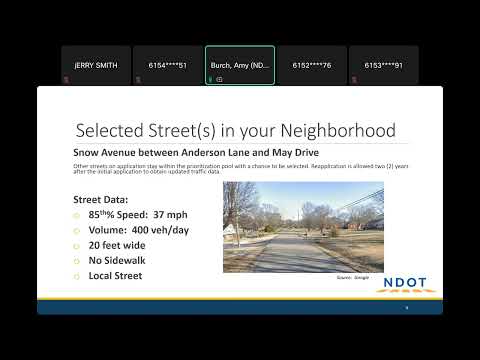
Burch said Snow Avenue ranked among the 25 streets selected last year for NDOT’s neighborhood traffic-calming program after field data showed an 85th‑percentile speed of 37 mph on a street posted at 25 mph, daily volume near 400 vehicles and no sidewalks. “We measured the 85th percentile speed to be 37 miles per hour whereas the speed limit is 25,” she said, citing that figure as a key factor in selection.
The draft concept shown to residents places five sets of speed cushions between Anderson Lane and May Drive, averaging about 450 feet between sets and using one cushion per travel lane to fit the roughly 20‑foot roadway. Burch described design constraints — driveway locations, vertical grade and tight curves — and said NDOT would complete two months of detailed design before launching an online ballot.
If the ballot succeeds — defined by NDOT as at least 66% of votes cast from properties that abut the affected right-of-way — the agency estimates construction would follow in about 8–10 months. Burch said the ballot will be open for six weeks, sent to property owners by unique mailer IDs, and that eligible voters include residential properties, churches and schools that directly abut Snow Avenue. For this project NDOT identified 46 eligible properties.
Neighbors on the call expressed objections. “How can we stop this? I hate those speed bumps,” one resident said, adding that preference for or against cushions was a deciding issue when they purchased their home. Another resident asked why a sidewalk could not be installed instead; Burch responded that sidewalks are selected through a separate, larger program and that NDOT cannot substitute a sidewalk for traffic-calming devices in this application.
Residents also raised concerns about outreach and turnout, noting low meeting attendance. Burch said ballots historically draw higher participation than meetings but offered to hold a second neighborhood meeting and provide multilingual mailings if the council member or residents request additional outreach. She also noted NDOT’s non-vertical alternatives — radar speed-feedback signs and pavement markings — would be pursued if the ballot fails to reach the 66% approval threshold.
Burch cited NDOT before-and-after measures from other local streets showing average speed reductions (for example, a study cited where average speed dropped from 31 mph to 22 mph after cushions) and said those results align 85th‑percentile speeds with posted limits on similar streets. Some residents voiced concerns that vertical devices slow emergency responses; Burch acknowledged the concern and said device spacing and design consider emergency vehicle needs.
Next steps: NDOT will complete fieldwork and the final design, notify the council member, and—unless additional meetings are requested—post plans and open the six-week ballot roughly two to three months after design begins. Ballot results and project status will be posted on NDOT’s traffic-calming project pages and the Engage.Nashville project site.