Get Full Government Meeting Transcripts, Videos, & Alerts Forever!
Get email alerts on the Land Use topic
No spam. Unsubscribe anytime.
Red Hook board closes hearing on North Broadway study, approves trustee’s historic‑resources table with AI disclosure
Summary
The Red Hook Village Board closed the continuation of its public hearing on the Northeast Quadrant Land Use and Zoning Study and approved a trustee‑prepared revision to the study’s historic‑resources inventory, requiring full source citations and an appended note disclosing use of AI in preparation.
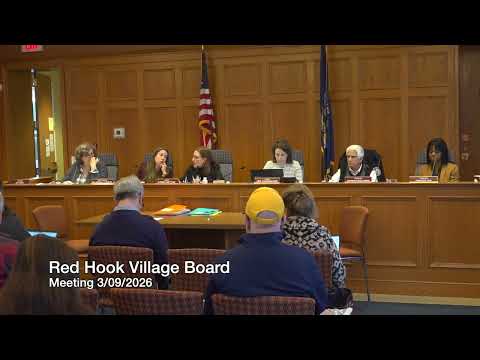
The Red Hook Village Board closed its continuation of the public hearing on the Northeast Quadrant Land Use and Zoning Study and approved a revised approach to the plan’s historic‑resources section, trustees said at the March meeting.
Trustee Uku moved to replace the existing historic‑resources table with a condensed table prepared by Trustee Uku; the motion was amended to require complete source citations and an explicit statement that the table “was prepared by Trustee Uku with use of AI” and to place the full narrative material into an appendix for verification by the consultant. Trustee Fran seconded the amended motion. The board voted to approve the amended motion during the meeting.
Bonnie Franson, the village’s planning consultant, said County Planning staff indicated a favorable review of the plan’s General Municipal Law (GML) items once a technical EF form is received. “He essentially was waiting for one piece of information…the EF form,” Franson said, describing her conversation with Clayton Gernett of Duchess County Planning.
The change to the historic‑resources presentation followed public comment and internal edits. Resident Rick East supported shortening and clarifying the language, saying the condensed table would make it “easy to read and easy to understand” for developers and for use in potential legal review. Trustee Fran and other board members debated whether to retain longer narrative descriptions for properties such as the Martin Homestead—the consultant noted the Martin Homestead is documented in the Historic American Building Survey (HABS) and has a comparatively large archival record.
Board members agreed to keep the fuller narratives available in an appendix to avoid omitting owner‑provided detail and to direct the consultant to verify and format full citations. In discussion, trustees also asked that any AI use be disclosed in the study so readers can identify which portions originated from trustee drafting assisted by AI and what primary sources were used.
Consultant Franson told trustees that adoption of the study will be subject to State Environmental Quality Review (SEQR); the board reviewed a Full Environmental Assessment Form (EAF) that treats the adoption of the study as a Type I action because the study area exceeds 25 acres and includes properties listed on register inventories. Franson and Village Attorney Victoria Polydoro said any future, site‑specific development proposals would undergo separate SEQR review.
The board set a date to finalize revisions and planned a workshop to review county comments when they arrive. Polydoro advised that if Duchess County Planning returns substantive comments after the hearing is closed, the board should reopen the hearing to permit additional public comment.
What’s next: the planning consultant will circulate a redline reflecting the agreed edits and the trustee‑prepared table with source citations; county comments, when received, will determine whether the board needs to reopen the hearing or may proceed to adoption and a negative SEQR declaration.
(Reporting note: statements in this article are attributed to speakers who made those remarks during the board meeting. When a direct quotation was not available in the transcript, the account paraphrases the substance of the speaker’s remarks.)