Get Full Government Meeting Transcripts, Videos, & Alerts Forever!
Get email alerts on the State Preemption Zoning topic
No spam. Unsubscribe anytime.
Board member warns state 'BUILD Act' would strip McHenry County of local zoning control
Summary
Board member Shorten told the McHenry County Board that Illinois HB 5626 (the "BUILD Act") would preempt local zoning authority, impose density and parking mandates statewide, limit local impact fees and give developers legal remedies against communities that do not meet an eight‑month compliance window.
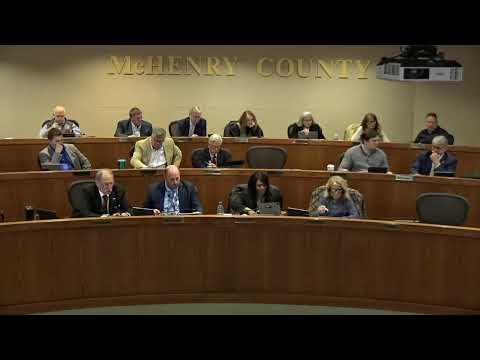
Board member Shorten warned the McHenry County Board on March 18 that Illinois House Bill 5626, which he called the "BUILD Act," would sharply curtail local land‑use control if passed in its current form. Shorten said the bill would set density standards "by right" for every residential lot and bar municipalities and counties from imposing requirements more restrictive than state standards.
"Eight months after passage, every residential zone lot in every municipality and in unincorporated McHenry County must follow the following density by right," Shorten said. He described a tiered entitlement structure in the bill that would allow up to eight units on lots larger than 7,500 square feet and permit multiple accessory units on smaller lots with no setback, design review or special permit.
Shorten also said the bill would cap parking at a half‑space per unit for multifamily projects and eliminate local parking minimums regardless of a community's driving patterns. "This bill takes away the right of this board and every municipal body in this county to protect that choice," he said. "There's a word for a governing philosophy that systematically replaces local decision‑making with centralized mandates: that word is totalitarianism."
He warned that missing the bill's compliance deadline would void local ordinances, and that developers could sue communities and recover attorney's fees if they prevail. Shorten argued the measure would replace locally negotiated impact fees with a state spreadsheet for fee calculations and exclude local school and park districts from negotiations.
Shorten framed the issue as one of local character and urged residents to contact their state legislators: "The window to act is now, when the bill is still in committee. I'm asking every board member, every resident ... to call not just your state representative and your state senator, but all the state senators and all the state representatives to sign on as a sponsor or a co‑sponsor."
Context and next steps: Shorten placed the bill in a longer pattern of state preemption, citing recent laws that limited county authority over utility‑scale solar and parking near transit. The board did not take formal action on HB 5626 at the March 18 meeting; Shorten asked constituents to engage their state legislators while the bill remains in committee.