Get Full Government Meeting Transcripts, Videos, & Alerts Forever!
Get email alerts on the Wastewater And Water Quality topic
No spam. Unsubscribe anytime.
Falmouth committee weighs watershed plans amid 40B housing and fertilizer enforcement concerns
Summary
Town committee members and residents debated how Massachusetts 40B housing rules intersect with local watershed management plans, questioned how fertilizer-reduction claims will be measured and enforced, and discussed possible local and legislative steps including home-rule ideas for urine-diverting fixtures; motions were made to continue parts of the discussion to the next meeting.
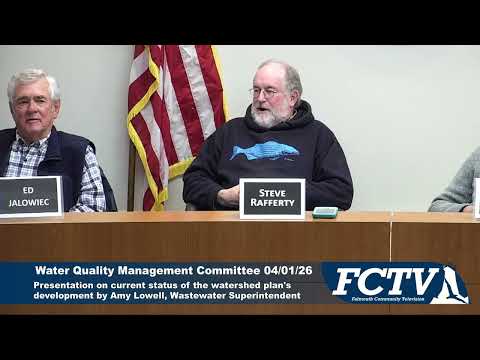
FALMOUTH — Members of a Town of Falmouth committee and several town residents discussed how state housing rules and local enforcement will affect the town’s efforts to meet total maximum daily load (TMDL) targets and improve water quality.
A participant opened the meeting by raising the tension between Chapter 40B comprehensive-permit rules and the town’s wastewater and watershed-planning obligations, saying the statute “overrides local regulations but it doesn't override state regulations,” and asking whether Cape Cod or Falmouth could pursue special-area controls to limit high-density projects that would increase nitrogen loads. Committee members agreed the issue means the town may need to coordinate with its legislative delegation on potential changes to 40B or pursue local policy responses.
Why it matters: The committee is drafting watershed management plans that state regulators have scheduled for submission; the first plans are due by the end of the calendar year, roughly nine months away. Those plans will feed into decisions about where to extend sewers, what alternative nitrogen-reduction measures to rely on, and how to monitor whether those measures actually reduce nitrogen in estuaries and ponds.
Committee staff told the group that state review responsibilities are split: the Department usually handles watershed-permit regulations while the Massachusetts Environmental Policy Act (MEPA) office reviews broader environmental impacts. MEPA, staff said, has been cautious about reviewing five-year updates unless they include a discrete infrastructure project, leaving uncertainty about how the state will treat routine watershed-plan submissions.
Residents and advocates pressed the committee on enforcement and measurement. “What town department is working to reduce the amount of nitrogen entering our coastal and inland water? Is anyone quantifying this?” asked Kim Kmart of the Pond Coalition. Staff answered that the watershed plans will include an estimated fertilizer reduction in kilograms per year, but acknowledged the town currently lacks an enforcement program and does not yet have a clear plan for measuring fertilizer reductions.
Multiple commenters and members highlighted practical trade-offs. Earl, speaking for the Barnhard Green Center, asked how the town will know whether lack of improvement is caused by failed non-sewer alternatives or by sewers themselves; presenters said sewer nitrogen removal is more directly quantifiable, while many alternative measures are harder to measure and may take longer than five years to show ecosystem change.
The meeting also heard a proposal from Hilda of the Manga Green Center to press the state or pursue a home-rule petition requiring urine-diverting fixtures in new high-density developments. Hilda said diverting urine could capture a large share of nitrogen at source; several members said the idea merits further study and could be the basis of a recommendation to the select board.
Maggie McGaw of the Falmouth Pond Coalition supported the urine-diverting proposal and suggested the town could use revenue from a short-term rental bylaw to fund a townwide enforcement officer tasked with enforcing nitrogen-related bylaws as well as rental rules.
On technical questions, members noted that TMDLs specify concentration thresholds (a presenter cited a threshold of about 35.36 milligrams per liter at one sentinel station) but typically do not prescribe how often the concentration must be below that level. That statistical variability and sampling-frequency questions complicate appeals or requests to the state to remove a waterbody from an impaired list.
Coordination between local regulators drew concern: the board of health has designated additional areas for local IAS (innovative/alternative systems) requirements that extend beyond state-designated nitrogen-sensitive areas, and several participants urged closer alignment between the board of health and watershed planners to avoid overlapping or conflicting requirements and to ensure fairness in who bears costs.
Procedural steps: the committee agreed to carry several remaining agenda items to the next meeting. Members moved to continue the RME/RE discussion to the next meeting, accepted the minutes with minor spelling corrections, and voted to adjourn; the votes were recorded verbally with all in favor.
What’s next: Staff and committee members said the watershed plans and associated monitoring programs will be developed over the coming months and will determine implementation pathways that likely involve cooperation with the board of health, possible town-meeting bylaws, and outreach to state agencies and the legislative delegation. The committee asked staff to bring clarifying details and corrected tables to the next meeting.
Ending: The committee closed after moving several discussion items forward for the next meeting and accepting minutes with corrections.