Get Full Government Meeting Transcripts, Videos, & Alerts Forever!
Get email alerts on the Housing topic
No spam. Unsubscribe anytime.
Vallejo planning commission recommends council approve 2025 general plan and housing-element progress report
Summary
The Vallejo Planning Commission voted to recommend City Council approval of the 2025 General Plan and Housing Element annual progress report, noting 193 permits issued in 2025 and continued work on renter-protection and inclusionary-housing ordinances to address outstanding RHNA shortfalls.
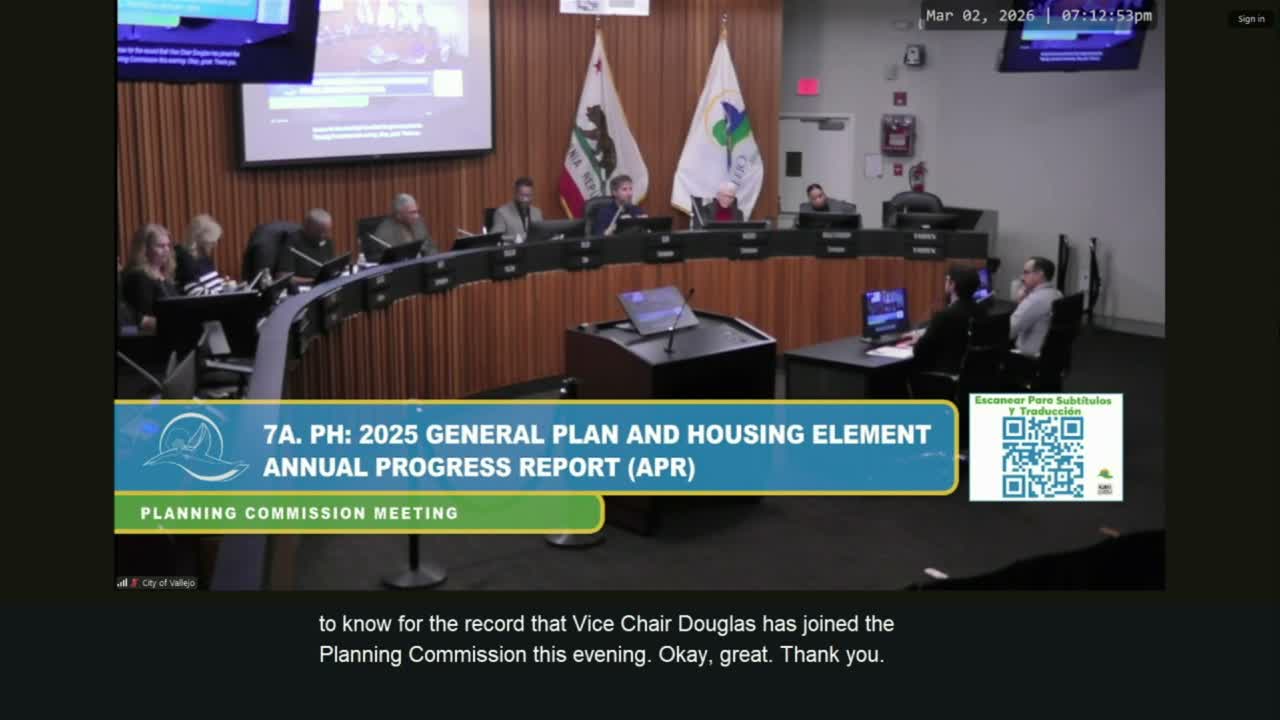
The Vallejo Planning Commission voted to adopt a resolution recommending City Council acceptance of the 2025 General Plan and Housing Element annual progress report on the evening the commission met, approving the recommendation by a 6-0 vote.
Senior Planner Robert Busick presented the report, saying the city’s Propel Vallejo general plan directs growth to 2040 and the annual progress report documents implementation activity for 2025. Busick told commissioners Vallejo issued building permits for 193 housing units in 2025 — including seven very-low-income units, 33 low-income, 10 moderate-income and 143 units affordable to above-moderate households — and that the city has produced 530 units toward its sixth-cycle RHNA of 2,900, leaving 2,370 units to permit through 2031. “The APR provides the city and the state with the implementation status and our jurisdictional share of RHNA,” Busick said.
Busick told the commission a $1.4 million Bay Area grant was reprogrammed to support a downtown specific-plan update that will fund community engagement and feasibility analysis for anti-displacement policies, such as potential rent-stabilization measures, just-cause eviction standards and right-to-counsel programs. Staff also reported that EPS completed an inclusionary-feasibility study and a commercial-linkage nexus study in June 2025; staff received direction in November 2025 to proceed with ordinance drafting and indicated draft ordinances are expected in mid-2026.
Commissioners pressed staff on how mixed-use prototypes were considered in EPS analyses and how the inclusionary and linkage-fee ordinances would be timed. Hector Rojas, the city’s long-range planning manager, said mixed-use prototypes were not part of the EPS feasibility prototypes but will be studied as part of downtown and waterfront specific-plan updates, which will include economic subconsultants to test market feasibility and prototype types.
Public commenters urged the commission to document delays and push for stronger renter-protection measures. A caller who identified herself as “Crystal” said key deliverables tied to program F1.1.3 were late and stressed the APR must record where the city is behind so state reviewers can identify local constraints. Liat Meitzenheimer of the Vallejo Housing Justice Coalition called for urgency on anti-displacement work and for following through on infill and mixed-use opportunities in commercial corridors.
After discussion, the commission’s chair moved to adopt the resolution recommending City Council approval of the APR; the motion was seconded and carried with six ayes. The commission also directed staff to provide monthly updates on pipeline projects and long-range initiatives and to circulate draft ordinance materials for public review once the city attorney’s office completes drafting based on the EPS nexus studies.
What’s next: staff expects draft ordinances for inclusionary housing and the commercial linkage fee in mid-2026, and staff said the downtown specific-plan engagement funded by the $1.4 million grant will continue into 2026. The commission will forward the adopted resolution and the APR to City Council for consideration.