Get Full Government Meeting Transcripts, Videos, & Alerts Forever!
Get email alerts on the Homelessness topic
No spam. Unsubscribe anytime.
Vallejo Council authorizes development of lived‑experience stipend program amid intense homelessness debate
Summary
After a lengthy staff briefing, public commentary and council debate, Vallejo officials directed staff to develop a paid ‘lived‑experience’ engagement program and return with parameters and a housing strategy; the council also discussed encampment pause outcomes, warming-center usage and White Slough cleanup options.
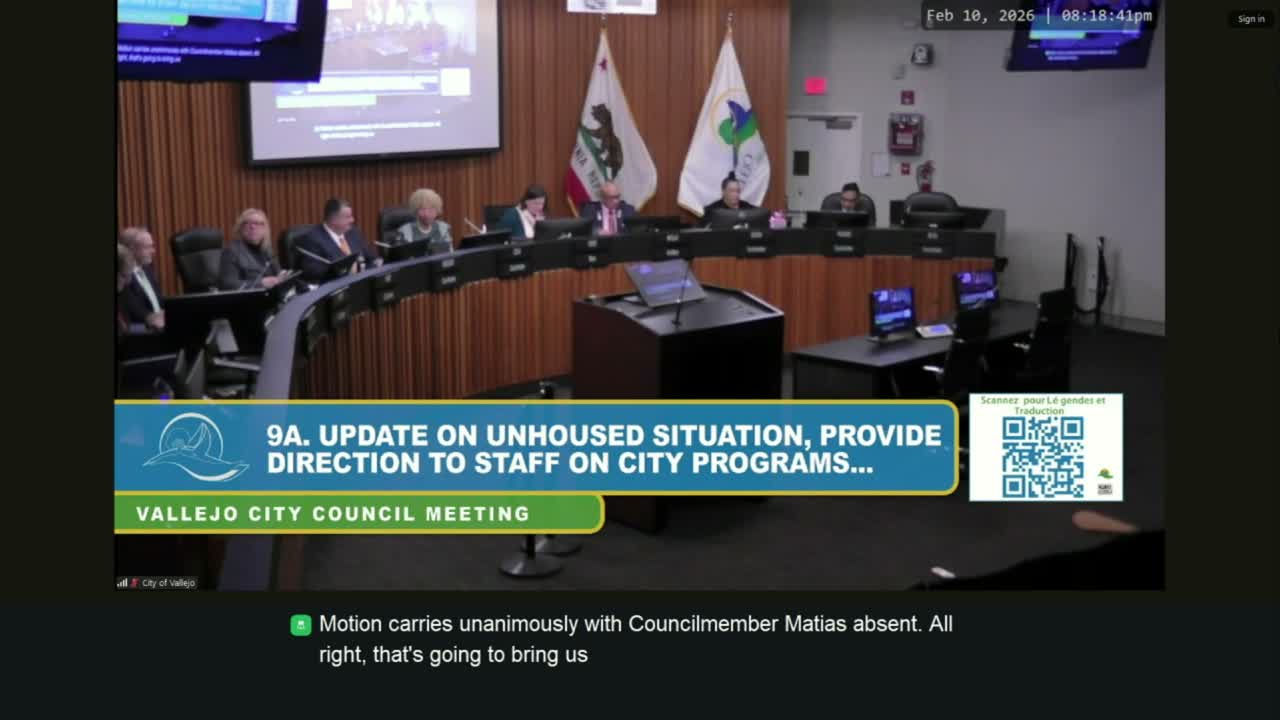
Vallejo — City staff on Tuesday gave the City Council a detailed update on homelessness outreach, the Jan. 29 point‑in‑time (PIT) count and a temporary pause on encampment removals, and councilmembers voted to authorize staff to develop a lived‑experience stipend program and return with policy parameters and a housing strategy.
Assistant City Manager Manny Conley told the council volunteers from the region carried out the Vallejo portion of the PIT count the morning of Jan. 29 and that about 45 of roughly 80 volunteers showed up. "We had approximately 80 volunteers who signed up, and approximately 45 of those volunteers showed up the morning of the point in time count," Conley said, adding that the city received roughly 400 interview or observation submissions that will be processed by the contracted PIT vendor.
Conley said the countywide PIT count showed a preliminary 33% decrease in submissions compared with the previous count, and staff noted that recent openings of shelter and housing — including the Navigation Center, Blue Oak Landing and Broadway Village — are likely contributors. Staff also reported the city conducted removals at roughly 30 encampment locations during the pause and provided a staff‑time cost estimate described in the presentation as about $2,000 per day (staff‑time only) for cleanup operations.
The council also heard public testimony from people with lived experience and service providers who urged clearer coordination and more humane, low‑barrier options. Barbara Simpson, a founding member of Vallejo’s SIOT team, disputed a characterization in a public packet that SIOT declined to coordinate, and said the team produced trackers and outreach records to staff. “The characterization of the SIOT that it declined to coordinate or report is an inaccurate statement,” Simpson said.
Other public speakers urged stronger succession planning for services, better outreach to encampments and protection of residents’ possessions during any abatement. Sally Griffith, co‑chair of a lived‑experience committee, urged the city to use existing lived‑experience groups instead of creating redundant committees.
Councilmembers debated whether to authorize up to the amount listed in the staff report to pilot stipends for people with lived experience to participate in policy and program design and how to set eligibility and oversight. Several councilmembers said they support compensating people for their time but stressed that the program should include clear parameters and equitable selection criteria. Councilmember Paul Maris pressed staff to bring a homelessness strategy back for council review; staff said a draft exists and staff will resume work on it.
In the evening’s formal action, the council instructed staff to move forward with developing a lived‑experience stipend program, to set parameters and to return with a housing‑strategy plan and reporting. The motion passed with one recorded opposition noted in the public minutes; the council also asked staff to refine tracking and coordination with outreach partners and to report back on White Slough remediation options and cost estimates.
What’s next: Staff said they expect to return with more detailed program parameters and a housing strategy for council consideration and asked for guidance on payment logistics, noting the city is exploring options beyond mailed checks to distribute stipends more quickly to people without stable mailing addresses.
(Reporting based only on council meeting transcript. The council’s staff packet and final adopted motions contain the official program amounts and policy language.)