Get Full Government Meeting Transcripts, Videos, & Alerts Forever!
Get email alerts on the Affordable Housing topic
No spam. Unsubscribe anytime.
Vallejo successor agency reviews plan to subordinate affordability covenant so Marina Towers Annex can refinance and be rehabilitated
Summary
The successor agency heard a developer presentation on subordinating the city's affordable-housing covenant to allow a refinance and $5.1M+ rehabilitation of Marina Towers Annex, a senior building; council members pressed for quarterly capital-asset reports, resident-engagement updates and details on elevator reliability and relocation plans. The item will be considered by the housing authority on consent.
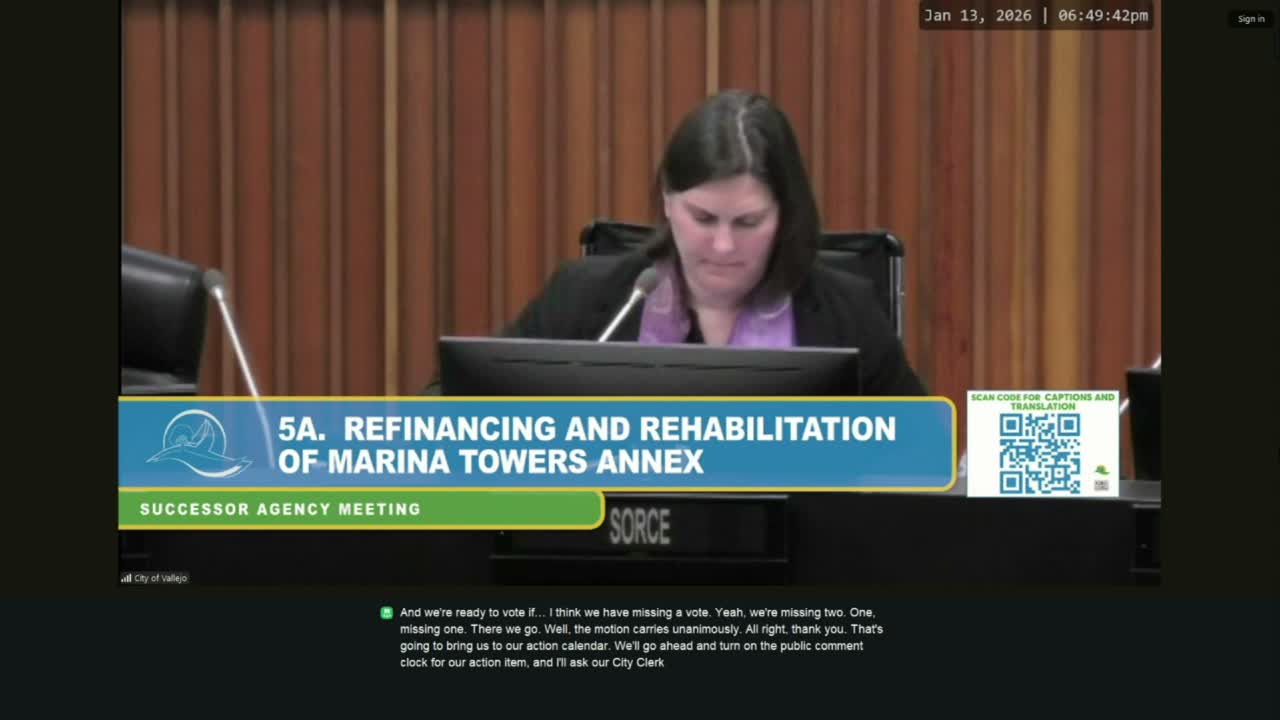
The successor board to the former Vallejo redevelopment agency on Thursday heard a developer's request to subordinate the city's affordable-housing covenant so Marina Towers Annex can refinance and undergo a planned rehabilitation.
Assistant City Manager Hain and Evan Laws, development manager at Vitus, told the board the annex is a low-rise senior building with one-bedroom units that is covered by a Section 8 HAP contract and needs significant repairs. Laws said the project would layer tax-credit regulatory covenants with a long-term financing package to preserve affordability and pay for renovations.
The request would allow the property's new owners to refinance through Fannie Mae and a HUD loan that together require subordination of the city's current covenant. "We are requesting approval of the presented resolution to allow for the subordination of the city's existing affordable housing covenant, in order to preserve this housing as quality and affordable housing, for years to come," Laws said during his presentation.
Why it matters: The annex houses seniors (the presenter said average resident age is 78 and average household income about $16,000). The developer told the board the Section 8 contract currently covers all units and is set to expire in October 2061; a regulatory agreement tied to tax credits would layer additional affordability protections out to roughly 2082. Council members said keeping the property maintained and safe for residents is their top priority.
What the developer said: Vitus described a scope of work that includes new windows, roofing, HVAC, flooring, appliances, doors and cabinets, elevator modernization, fire-alarm upgrades, perimeter fencing and security cameras, and a rooftop solar system intended to lower residents' utility costs. The developer listed a construction cost for the rehab of just over $5.1 million and said Wilshire Pacific Builders is the contractor; John Stewart Company will continue property management.
On funding, Laws said the team has an award from the California Tax Credit Allocation Committee and plans to combine tax-credit equity with a 40-year Fannie Mae loan to finance the work. The transcript contained inconsistent dollar splits in the presentation, and the exact capital-stack numbers were not clearly stated on the record.
Council concerns and exchanges: Council members pressed the developer on long-term asset management, asking how the property will be kept from returning to disrepair once renovations are complete. One council member asked, "How are we gonna ensure that this property doesn't go back into disrepair? What is the asset-management process that's gonna be taking place?"
Laws responded that Vitus maintains an active asset-management team, holds weekly calls with property management, and will pre-fund a replacement reserve. "We do have a replacement reserve account which is gonna be pre-funded at an amount of $300,000," he said, adding that the operating budget will deposit about $350 per unit annually thereafter to support capital needs.
Council members also raised elevator reliability and resident safety given the senior population. The developer said elevator modernization is part of the renovation and that interim measures (repair parts, coordination with local fire departments to assist residents when elevators fail, and other operational responses) will be used while permanent upgrades are completed. The transcript includes an inconsistent reference to the schedule: the developer initially described construction as set to begin in March 2026 with a roughly 12-month timeline, and in a later reply gave a date that implies March 2027 as a completion point; the record is not internally consistent about exact start and end dates.
Relocation plan: The developer described a phased, temporary relocation plan in which residents would be moved off-site while individual units are worked on. Standard units would typically require about 10 calendar days away and ADA-upgrade units about 20 days; the developer said all relocation, extended-stay and transportation costs would be covered by the project and that identified housing options included Extended Stay America and locations near Hilltop Mall.
Procedural status and reporting: City Manager Murray asked that quarterly reports on capital asset management and regular updates on resident engagement and construction progress be included. A council member moved to adopt a resolution approving the subordination agreement and explicitly included quarterly reporting and regular construction updates in the motion. The successor-agency meeting adjourned before a recorded vote on this item; the presiding officer said the same item would be considered next by the Vallejo Housing Authority on consent.
What's next: The item is slated for the Vallejo Housing Authority meeting immediately following this successor-agency session, where it will appear on consent. If approved there, the subordination would allow refinancing and the planned rehabilitation to proceed, subject to the terms of the regulatory agreements and any conditions the housing authority imposes.
Sources and limits on the record: The article relies on the successor-agency meeting transcript. The presentation included some inconsistent numeric detail for the loan and tax-credit split on the capital stack; those exact figures were not unambiguously recorded in the transcript and are reported here only where clearly stated (rehab cost over $5.1 million; replacement reserve $300,000; Section 8 HAP contract expiry October 2061; planned regulatory term to about 2082).