Get Full Government Meeting Transcripts, Videos, & Alerts Forever!
Get email alerts on the Paratransit topic
No spam. Unsubscribe anytime.
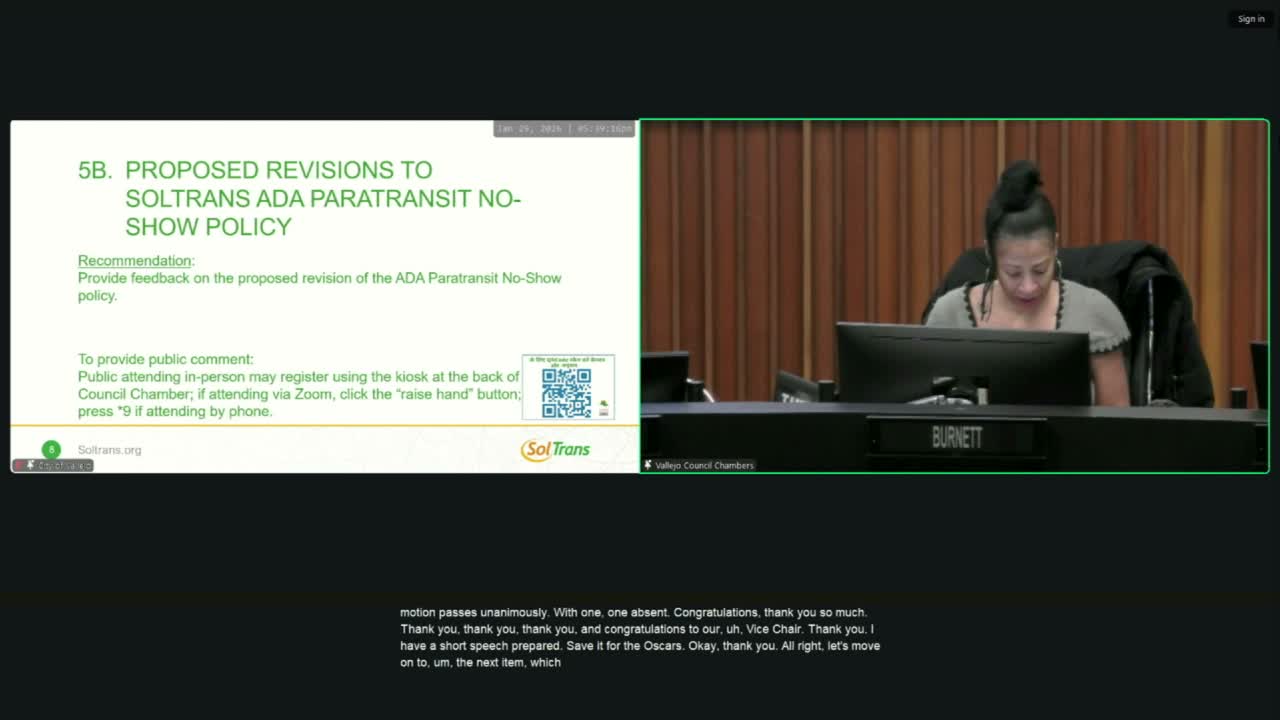
SolTrans PAC endorses revisions to ADA paratransit no‑show policy, adds appeals process
Summary
The PAC endorsed changes to the ADA paratransit no‑show policy: a rolling 30‑day counting window instead of calendar months, a shortened advanced cancellation window from two hours to one hour, and an appeals process; staff reported outreach (500+ letters) and early declines in no‑shows.
The SolTrans Public Advisory Committee endorsed staff recommendations to revise the agency’s ADA paratransit no‑show policy, voting unanimously to open a public comment period and forward the matter to the board with PAC feedback.
Staff member Angel presented the proposed changes and said SolTrans had mailed more than 500 letters to current paratransit riders as part of outreach. Angel said staff recommended switching from a calendar‑month counting method to a rolling 30‑day instance window and reducing the required advance cancellation time from two hours to one hour. The proposal also adds a formal appeals process so riders can explain extenuating circumstances and request review.
Operational staff said they had been tracking rising late cancellations and no‑shows; their contractor logs no‑shows biweekly. Mandy, who described operations, said the letter outreach had already produced a notable decline in no‑shows. “Our contractor tracks that on a every 2 week basis, and we were seeing those numbers climb,” Mandy said, explaining the operational rationale for the shorter cancellation window.
PAC members and public commenters raised concerns and asked staff to clarify how the policy would treat dialysis riders, service animals, and situations where a problem was the agency’s fault. Cynthia Tanksley pressed for case‑by‑case discretion and said she was worried about riders with seizures or other sudden medical events being isolated by stricter enforcement. She asked whether agency errors—dispatch mistakes or drivers failing to pick up riders—would be counted as no‑shows; staff replied that agency errors would not be charged as a no‑show and that those processes would be clarified in the rider guide.
Member Avery Livingood asked for a clearer definition of a “second instance” under the rolling window; staff replied that an instance is a 30‑day period that starts on the first no‑show and that letters and cards are mailed after each no‑show to notify riders of the status and appeal options.
Councilwoman Gordon spoke during public comment and urged more proactive rider notifications (including suggested texting) and stronger written policy protections to avoid stranding passengers. Gordon said she appreciated staff’s move from two hours to one hour and asked that the dialysis question be returned with more detail at the board meeting.
The clerk called a roll for the endorsement; the recorded votes were affirmative from present PAC members, and the chair announced the motion passed unanimously.
Why it matters: Paratransit no‑show policies directly affect vulnerable riders who rely on ADA service for medical appointments and mobility; the changes aim to balance operational reliability with protections and a clearer appeals pathway.
Staff committed to clarifying language in the rider guide and the no‑show attachment, to confirm software/tracking details with the contractor, and to provide further detail on dialysis pickups at a future meeting.
Representative quotes from the meeting include Angel describing outreach: “We— sent out over 500 letters to every current paratransit rider,” and Cynthia Tanksley’s concern that the policy not “isolate” riders who experience sudden medical problems.