Get Full Government Meeting Transcripts, Videos, & Alerts Forever!
Get email alerts on the Domestic Violence topic
No spam. Unsubscribe anytime.
Vallejo expands domestic‑violence and trafficking response: new pamphlets, QR code, training and partner coordination
Summary
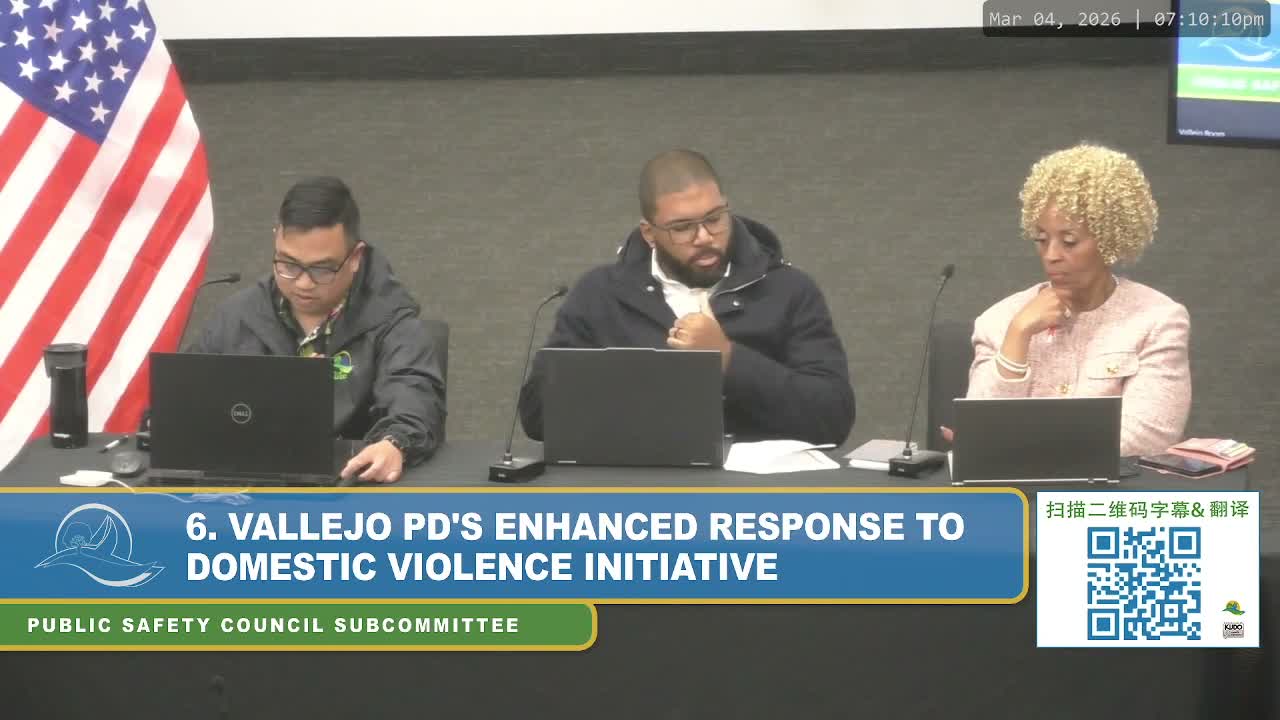
The subcommittee heard progress on the Vallejo Police Department’s enhanced domestic‑violence initiative, partner training outcomes (57 people trained), and plans to distribute a resource pamphlet with a QR code and to implement a lethality‑assessment train‑the‑trainer program with local partners such as the Family Justice Center, VEST and iHeart.
Vallejo officials and community partners on Tuesday outlined a stepped‑up, multi‑partner response to domestic violence and human trafficking that combines training, victim navigation and a new resource card the city plans to distribute widely.
The police department reported that a domestic‑violence resource pamphlet is nearly complete and will include trafficking resources and a QR code linking to local service information. Staff said the countywide pamphlet is under discussion and that the Family Justice Center will review the local pamphlet before final publication.
Staff told the subcommittee that the second of two trainings was completed Feb. 26 and that, collectively, training reached patrol officers, dispatch and iHeart staff. A partner representative said 57 people attended the training, which emphasized high‑risk indicators and the need for an after‑hours response capacity. "Those high‑risk indicators were really important for them," one partner said.
Family Justice Center and community partners — including VEST (Victims Empowerment Support Team) and the iHeart outreach program — described coordinated steps to connect survivors to services. Tanya Brownrigg, executive director of VEST, introduced her organization and said VEST will work with iHeart and local partners to provide direct services and materials in Vallejo.
Rayvon Williamson, program manager for iHeart, said his program is exploring how to align its 12‑hour service model with 24‑hour resources and partners. The Family Justice Center discussed plans to support a train‑the‑trainer course to implement a lethality‑assessment protocol; partners said determining who will provide 24‑hour response coverage is a priority before the lethality tool is fully implemented.
Regional anti‑trafficking partner Sharon DeNoah urged continued coordination. DeNoah noted that ReportJohn (an anonymous reporting tool for suspected trafficking/related harms) is now available in Vallejo and flagged a recent Bay‑Area enforcement operation that identified Vallejo as a hot spot; she offered regional partnership ahead of major events.
Committee members and staff agreed to continue refining the written domestic‑violence initiative, to include prevention and batterer‑intervention components, and to return a drafted proposal to the subcommittee for review next month. The department also said it will upload the resource pamphlet and QR code links to its website once finalized and will work with partners on after‑hours referral pathways.
Next steps: staff will bring the draft written initiative for committee review at an upcoming meeting and include updated partner roles, training timelines, and specifics about after‑hours coverage.