Get Full Government Meeting Transcripts, Videos, & Alerts Forever!
Get email alerts on the Domestic Violence topic
No spam. Unsubscribe anytime.
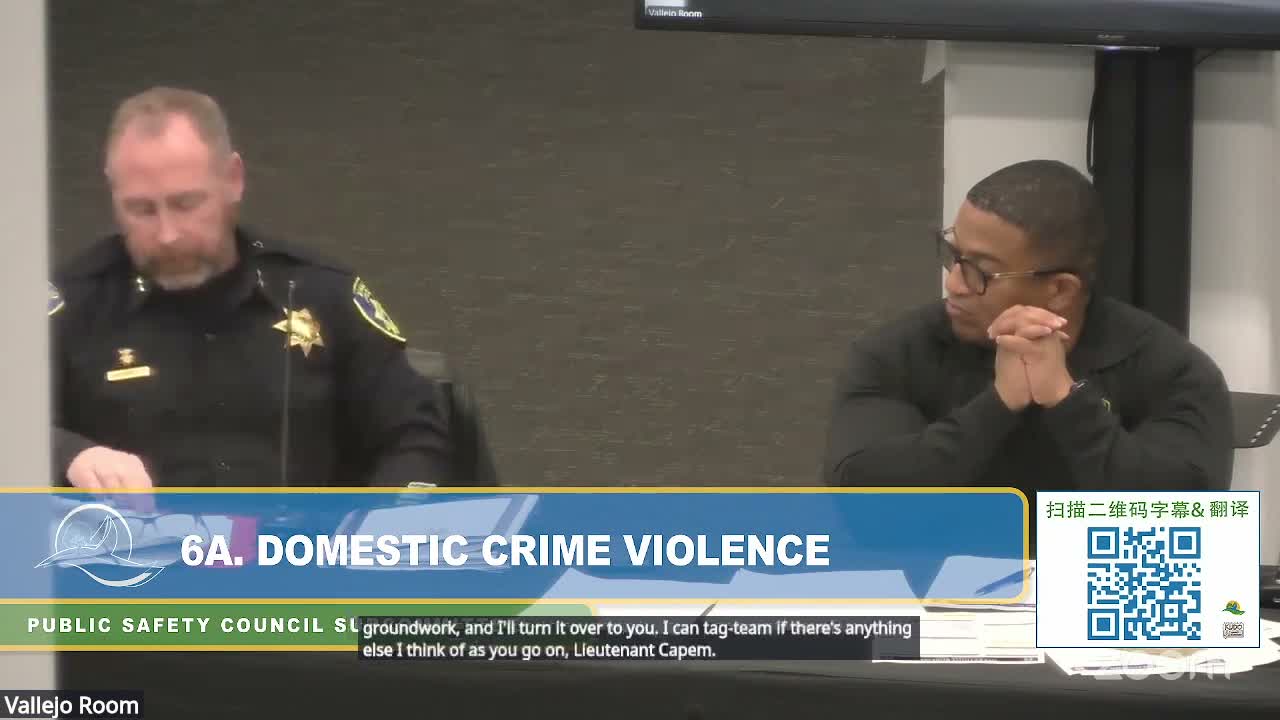
Vallejo subcommittee outlines lethality-assessment rollout and service coordination to strengthen domestic-violence response
Summary
Police, community providers and council members discussed repeat-offender data and a proposed lethality-assessment protocol, two-day trainings for officers and dispatch, resource-card consolidation countywide, immediate advocacy on-call and gaps in forensic-exam funding and evidence-storage that complicate timely care.
The Vallejo Public Safety Subcommittee spent substantial time on a coordinated plan to improve the citys domestic-violence response, hearing presentations from police investigators and local nonprofits about training, victim navigation and gaps in medical-forensic capacity.
The investigations lieutenant said the departments analysis found multiple repeat offenders responsible for several DV cases across 2024—25 and identified apartment complexes with the highest incident concentrations. He described interim outreach ideas (flyers, QR codes in property management offices) and a plan to consolidate resource cards into a countywide trifold so advocates can refer survivors regardless of municipal boundaries.
Police staff outlined a two-pronged training approach: immediate short briefings for officers and dispatchers, then a two-day, Department of Justice-approved lethality assessment training for patrol. The protocol would use a structured set of questions on-scene; a positive lethality score would trigger a live connection to an advocate during the first contact.
Community partners including representatives from the Solano Family Justice Center and an organization identified in the transcript as SaintsArt described available services, the 24/7 SafeQuest Solano hotline and benefits of quick forensic exams. A partner cited a San Diego study showing forensic exams increase prosecution rates by roughly one-third when victims sit with a forensic examiner, and urged the city to expand immediate access to advocacy and examinations.
Council members raised operational hurdles: the local lack of a crime lab and secure hospital evidence storage complicate on-site collection and chain-of-custody for forensic specimens; domestic-violence forensic exams currently lack state reimbursement (unlike sexual-assault exams) and therefore impose cost burdens on jurisdictions. Staff agreed to research options, to ask county and medical partners (including Kaiser) to explore custodial logistics so exams can be performed without undue delay to victims.
The subcommittee requested a concise implementation document: a program name, an action plan with timelines, milestones for training, roles for community partners, and clear decision points when council approval will be needed for contracts or additional funding. Staff said some initial work can proceed within departmental resources while components requiring additional spending would be forwarded to council.
The subcommittee did not vote on new ordinances but directed staff to continue partnering with county agencies, pursue grant options and return with the action plan for further subcommittee review.