Get Full Government Meeting Transcripts, Videos, & Alerts Forever!
Get email alerts on the Training And Complaints topic
No spam. Unsubscribe anytime.
Vallejo police chief recommends ride‑alongs, simulator training and highlights new complaints portal for oversight commission
Summary
Police leadership recommended experiential training for commission members — including ride‑alongs, dispatch sit‑alongs and the Virtra simulator — and described IAPro/iPro public‑portal tracking for complaints; commissioners pressed staff to explain how complaint confidentiality and email monitoring will be handled.
Vallejo police leadership recommended a mix of internal, experiential and national‑organization training to prepare members of the new Police Oversight Advisory Commission for oversight duties, and staff outlined a complaints‑tracking portal designed to let complainants follow the status of investigations.
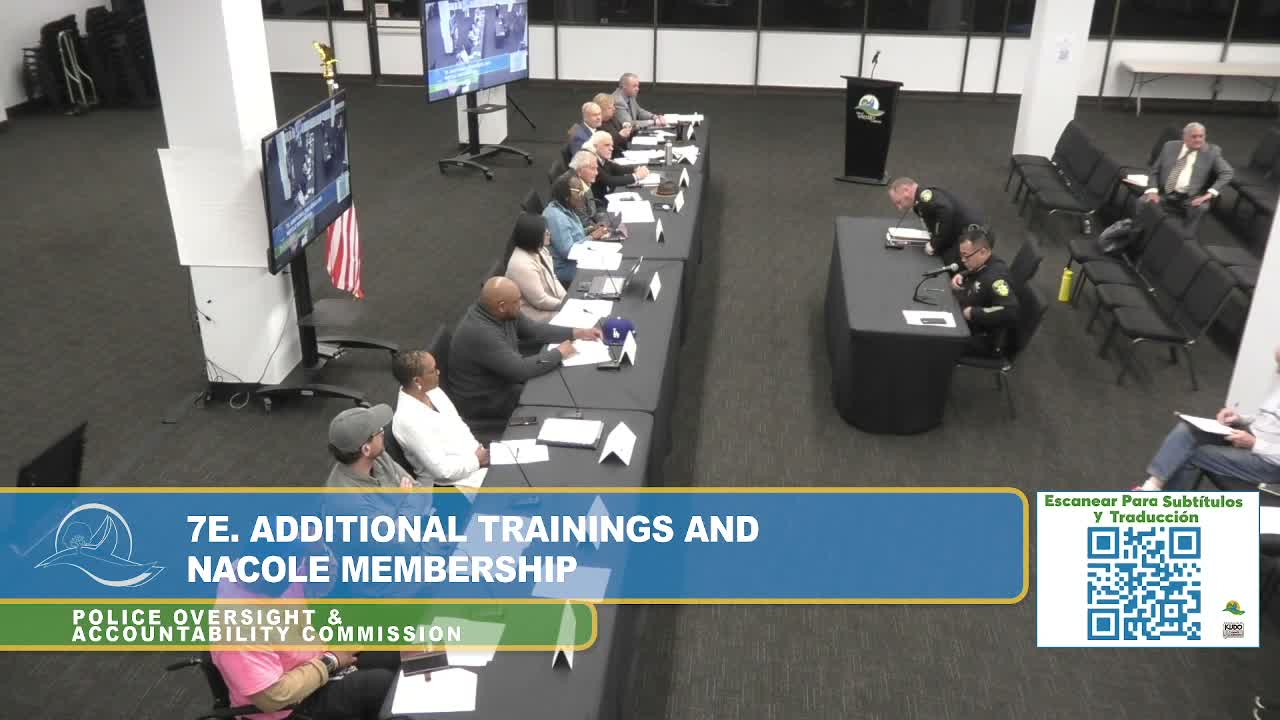
Chief Jason Taw (transcript: "Jason Taw, Valeo, chief of police") told the commission that training aligned with the National Association for Civilian Oversight of Law Enforcement (NACOLE) pillars and POST (Peace Officer Standards and Training) material would be useful. He recommended three internal experiences: ride‑alongs with patrol officers, dispatch sit‑alongs, and use of the Virtra simulator for high‑stress scenario training. "I think that, probably 2 a year would be beneficial," he said regarding ride‑alongs, and suggested one dispatch sit‑along annually.
Deputy Chief Bob Knight introduced himself as the police liaison to the commission and explained the department’s complaint‑tracking software. The department uses IAPro and an iPro public portal that, when complainants provide contact information, sends a link so they can track the status of their complaint. "So now when they file a complaint... the system can then communicate the status of their complaint to that complainant," Deputy Chief Bob Knight said.
Commissioners asked operational questions: who will set up ride‑alongs, whether the portal could provide read‑only access to commissioners, and which staff would receive commission email boxes. Staff said that the police department’s executive secretary can schedule ride‑alongs and that the city had set up commission email addresses that will auto‑forward incoming mail to the commission secretary, the city attorney and HR to ensure statutorily required timelines are met.
On confidentiality, commissioners and public commenters expressed concern that complaints forwarded to multiple offices could undermine public trust. Staff acknowledged the perception risk and committed to posting a clear explanation on the commission’s web page about what confidentiality means in practice and why complaint records are handled by multiple offices; staff also said the commission can be granted read‑only access to appropriate IAPro fields if operationally feasible.
What happens next: Staff will include training and membership (NACOLE/POST) in the POAC budget request and will bring proposals and scheduling options (including Virtra simulator slots and ride‑along coordination) to future meetings. The department and city staff will also prepare public‑facing materials explaining complaint intake, confidentiality and tracking.