Get Full Government Meeting Transcripts, Videos, & Alerts Forever!
Get email alerts on the Cfd Tax Policy topic
No spam. Unsubscribe anytime.
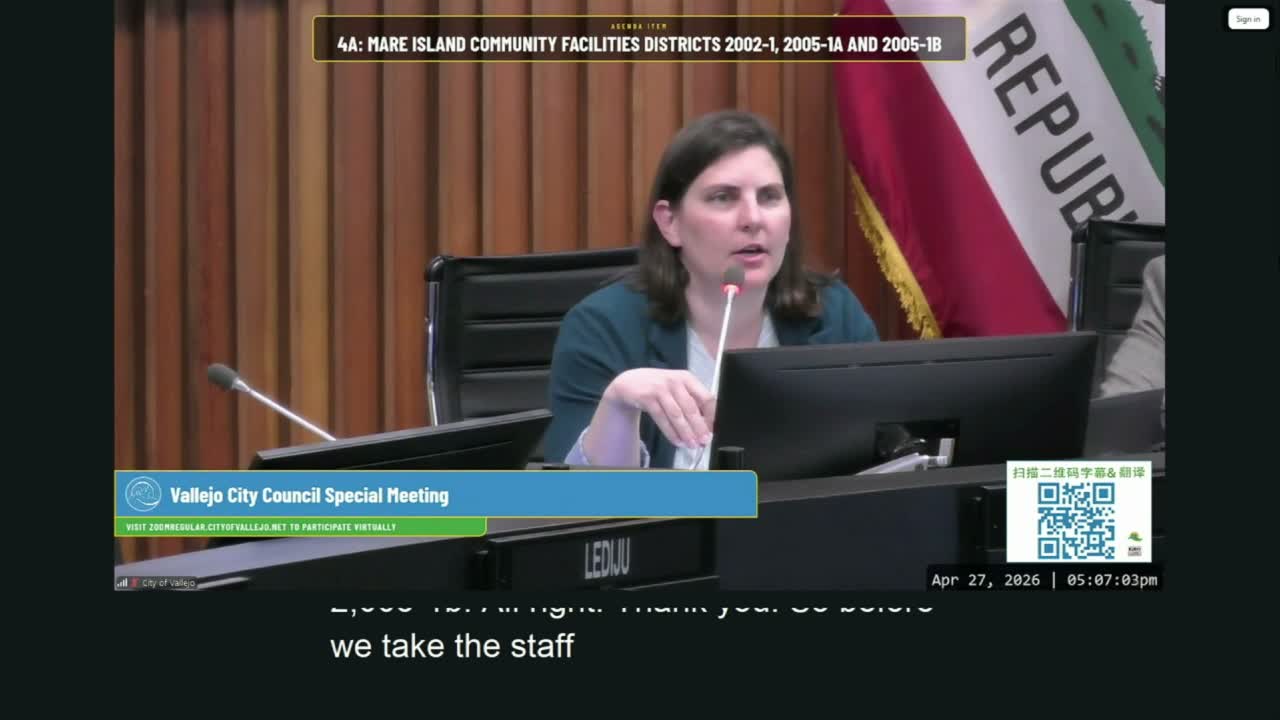
Vallejo council directs staff to study freezing a Mare Island CFD escalator and seeks state audit after residents’ pleas
Summary
After Mare Island residents detailed two decades of high special taxes, Vallejo council asked staff to analyze freezing a 2005 facilities special tax escalator, explore infrastructure financing options, and authorize the mayor’s office to send a letter to the state controller asking for follow‑up on a Feb. 2024 audit request. The motion passed unanimously.
Mayor Sors convened the Vallejo City Council meeting and, after more than two hours of resident testimony and consultant briefings, the council voted to direct staff to return during the budget process with options to freeze the annual escalator on the 2005 facilities component of Mare Island’s community facilities districts (CFDs), to explore other infrastructure financing tools and to ask the mayor’s office to send a letter to the state controller’s office following up on a Feb. 2024 inquiry.
The action followed a lengthy presentation by Sherry Anne Grimm, a spokesperson for Misty (Mare Island Special Tax Elimination Alliance), who told the council residents were not seeking to avoid taxes but to be taxed “fairly.” Grimm said the original CFD calculations were based on assumptions that never came to pass and that required offsets under the RMA (rate and method of apportionment) have not been fully applied: “We are not asking to avoid paying taxes… We have faithfully paid our taxes even though we feel that they are outrageously high and unreasonable for over 20 years,” she said.
Why it matters: staff and consultants told the council that reducing or eliminating elements of the islandwide CFD could have immediate consequences for the city budget. City staff and the city’s consultant presented a fiscal model showing that fully eliminating the islandwide CFD would create a roughly $3 million annual gap in the general fund and could shift funding burdens back to mainland Vallejo taxpayers. Conversely, residents said the existing formula and Goodwin method continue to force homeowners to pay the ‘‘max tax’’ while commercial ratepayers benefit first.
Consultant Susan Goodwin, a special‑tax consultant for the city, said CFDs that fund services exist across California, but confirmed the Mare Island arrangements were unusual in structure and origin. Outside counsel James Wozniak (Jones Hall), who reviewed formation documents, reminded the council that the original CFD formation had been validated in court and is legally effective: “The CFD has been validly formed, and is effective.”
Council action and next steps: Vice Mayor Matulik moved a package of directions requiring staff to: analyze freezing the 2005‑1a facilities escalator through the upcoming budget process; present options for infrastructure financing tools such as Enhanced Infrastructure Financing Districts (EIFDs) or tax increment mechanisms; and place a mayor’s‑office letter to the state controller on a future consent calendar to follow up on the Feb. 2024 controller inquiry. The council approved the motion unanimously with one member absent.
What the public asked for: Misty asked the council to (a) freeze annual escalators that increase the residential maximum special tax, (b) locate and document all offset revenues that could reduce the special tax, (c) commence the process laid out in the North Mare Island disposition and development agreement to create replacement CFDs paid by the developer, and (d) form a subcommittee to improve communications. Several speakers said incremental freezes could be done through annual levy decisions without rewriting the CFD documents, while staff counsel warned that some CFD language appears to require levying up to the maximum residential tax and that legal options for blanket freezes are constrained by the adopted RMAs.
What’s next: Staff will return with budget‑process options and legal analysis on freeze mechanics, and the mayor’s office will draft the letter to the state controller for council placement on consent. Councilmembers also asked staff to study EIFDs and other tools for long‑term island infrastructure financing and to bring more detailed analyses to the Mare Island subcommittee and budget hearings.
The meeting record shows the Council did not adopt any immediate tax credits or eliminations; rather it asked staff for analyses and for a follow‑up letter to the controller.