Get Full Government Meeting Transcripts, Videos, & Alerts Forever!
Get email alerts on the Housing Policy topic
No spam. Unsubscribe anytime.
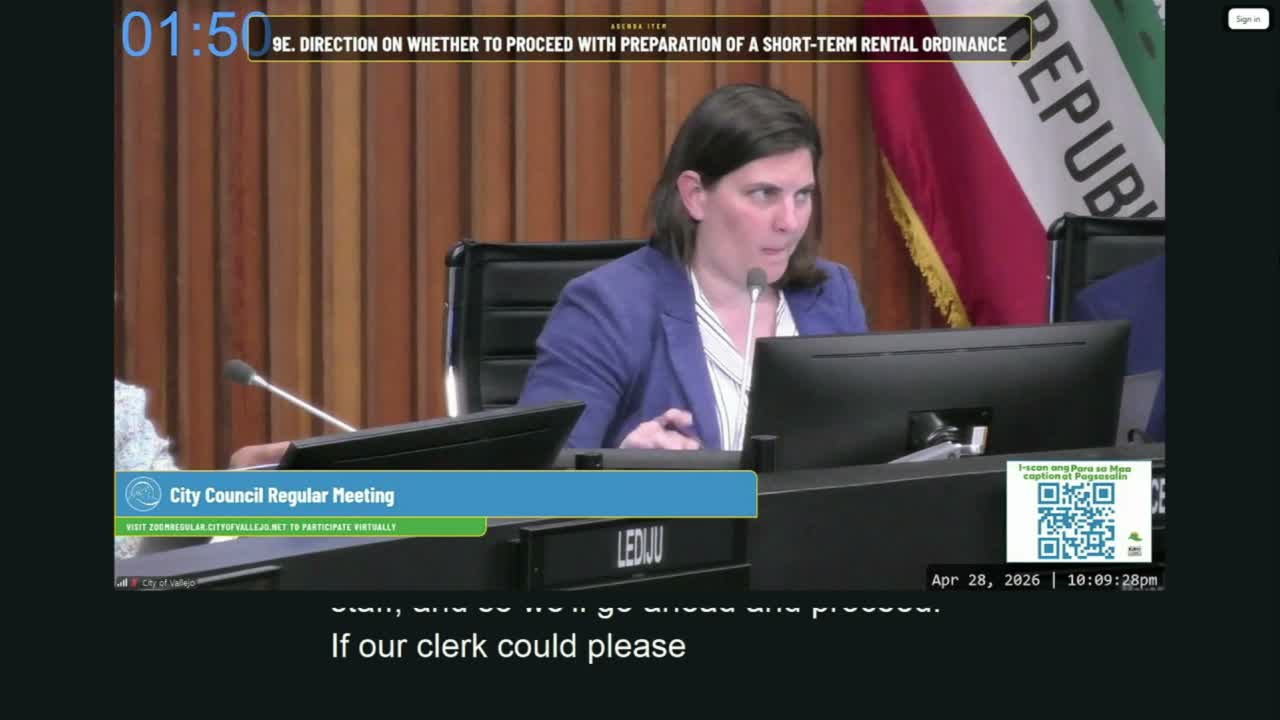
Vallejo council directs staff to develop short‑term rental ordinance, cites revenue and capacity tradeoffs
Summary
After reviewing market data estimating nearly $5 million in STR market revenue and a potential $550,000/year in TOT if fully compliant, the council unanimously directed staff to proceed with drafting an STR ordinance while emphasizing prioritization amid other housing ordinances.
The City Council directed staff to proceed with ordinance development for short‑term rentals (STRs) after a presentation summarizing local STR activity and regulatory options.
Planning staff reported AllTheRooms data showing about 194 active STR listings in Vallejo between March 2025 and March 2026, an average daily rate of about $246 and average occupancy near 29%. Staff used those figures to estimate an order‑of‑magnitude annual market revenue of roughly $5 million and noted that Vallejo’s 11% TOT rate could generate approximately $550,000 annually if the city were to reach full STR tax compliance.
Staff outlined policy tools that could be considered: registration/permit systems, primary‑residence requirements, annual or per‑listing licensing, limits on days rented per year, occupancy/parking/noise standards, local contact requirements, geographic caps and third‑party monitoring software. Preliminary consultant costs for ordinance drafting were estimated at $15,000–$35,000 with ongoing monitoring tools costing an additional $10,000–$15,000 per year depending on scope.
Council discussion focused on enforcement capacity, the need to prioritize the planning department’s workload (in particular inclusionary zoning and tenant‑protection ordinances), and options to balance mom‑and‑pop hosts against institutional investors. Several councilmembers recommended using external consultants and third‑party compliance platforms to ease code‑enforcement burden. Community commenters urged urgency because the unregulated STR market is active now and some argued for tenant protections to accompany any STR policy.
Outcome: council voted unanimously to direct staff to move forward with preparing an STR ordinance approach (including scope, community engagement plan and whether to issue an RFP for consultant assistance), and asked staff to return with a proposed development timeline and budget implications.