Get Full Government Meeting Transcripts, Videos, & Alerts Forever!
Get email alerts on the Police Accountability topic
No spam. Unsubscribe anytime.
Vallejo police present draft complaint policy emphasizing transparency, 30‑day updates and anti‑retaliation
Summary
The Vallejo Police Department outlined a drafted personnel complaint policy at a public town hall, promising new timelines (2 business days to notify oversight, 30‑day complainant updates, investigations up to a year), stronger anti‑retaliation language, and clearer oversight by the Police Oversight Accountability Commission (POAC). Residents pressed officials on body‑worn camera activation and how criminal and administrative investigations interact.
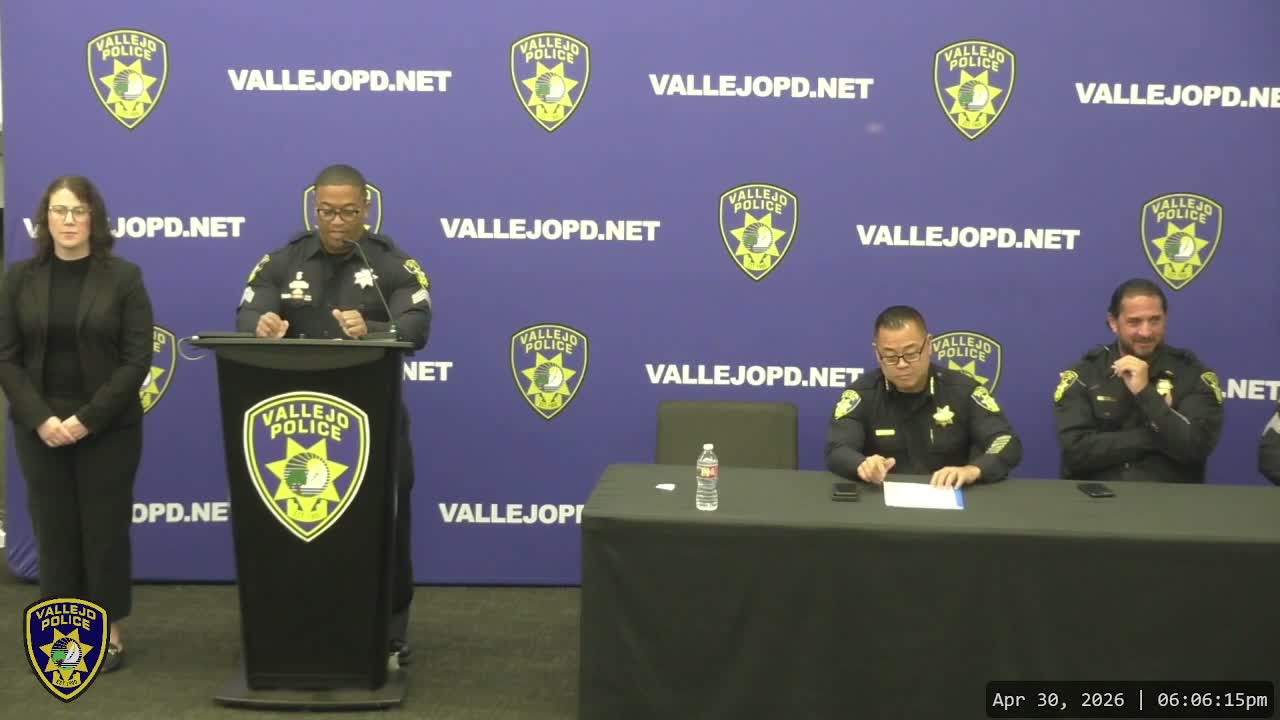
Sergeant Hollis, the Vallejo Police Department’s public information and community engagement officer, opened a town hall meeting to present a drafted personnel complaint policy and invited questions from the public.
Chief Jason Taw said the draft, developed in coordination with the California Department of Justice, the city’s evaluation team and labor representatives, is intended to “strengthen our practices through thoughtful evidence based approaches” and to reinforce “transparency, accountability and trust.” He described it as a collaborative step to standardize how complaints are received, tracked and resolved.
Lieutenant Jason Martinez, commander of the department’s Professional Standards Division, led a detailed presentation of the draft. He said the policy clarifies key definitions (a complaint can allege misconduct, discriminatory conduct, discourteous conduct or criminal conduct), adopts a preponderance‑of‑evidence standard (described in the presentation as “51% compared to 49%”), and explains a Skelly hearing as a pre‑disciplinary process that lets an employee respond before serious discipline is finalized.
Martinez described three complaint classifications: formal (for incidents requiring interviews and evidence collection), informal (for isolated, lower‑severity incidents) and public inquiries (where the allegation is found to be false or concerns service levels). He said anyone may file a complaint — anonymously or on another person’s behalf — and listed filing options (in writing, in person, by phone, email or online).
Under the draft, Martinez said, the Professional Standards Division will act as a central coordinator and quality control hub: it will log case numbers, track allegations and status, provide complainants with periodic updates every 30 days and produce public‑facing reports. He said the department has up to one year to complete an internal affairs investigation but that the administrative timeline can be tolled — or paused — while a related criminal investigation proceeds.
"By enhancing how we document, track, and communicate these interactions, we aim to provide the public with greater clarity into our processes," Chief Taw said.
Public attendees pressed officials on practical issues. Brianna Rogers, a District 4 resident, asked whether body‑worn cameras must always be activated and whether more formal rules could reduce gaps when an officer does not have a camera recording. Martinez said officers are required to activate cameras any time there is contact or confrontation with a citizen and that the department will review failure to activate as part of the totality of an incident. Department staff described an in‑car “wheel‑to‑wheel” practice that generally turns in‑vehicle cameras on when an officer exits a car and noted activation can include a short retroactive buffer (presenters described a ~30‑second pre‑activation clip).
John Garcia, a community organizer from Sacramento who said he has an ongoing complaint that overlaps a criminal matter, asked how the police department balances criminal prosecutions and administrative transparency. Martinez and Chief Taw said criminal investigations generally take precedence and the department will pause internal administrative timelines while criminal processes proceed; they also said information may be shared between criminal and administrative investigators only through proper channels and when permitted.
On oversight, Martinez and Chief Taw described the Police Oversight Accountability Commission (POAC), created by Vallejo Municipal Code Title 18, as an independent civilian body that can review cases, request outside investigators and advise on policy and training. Officials said serious incidents and bias complaints can be referred to POAC for outside review and that citizens may seek escalation to state authorities if local prosecutorial decisions do not satisfy them.
Residents asked about anti‑retaliation protections. Martinez said the draft contains stronger language prohibiting interference, discouragement, coercion and intimidation, and that sustained retaliation findings could lead to severe discipline, including termination. He said the department will try to remove an accused officer from contact with the complainant while an investigation proceeds.
The chief and Martinez said the draft is one part of a larger reform effort tied to the city’s settlement and oversight environment. They encouraged written feedback, noted the draft remains subject to change, and said the policy will be considered by POAC and the department’s vet team before finalization. Sergeant Hollis closed the meeting and said the recorded presentation would be posted on the city’s website with Spanish and Tagalog viewing options.
The department did not vote on the policy at the meeting. Officials said next steps include collecting public feedback, reviewing it with POAC and the vet team, and returning for further consideration. The department provided a copy of the draft at the meeting and online.