Get Full Government Meeting Transcripts, Videos, & Alerts Forever!
Get email alerts on the Data Centers topic
No spam. Unsubscribe anytime.
Gary forum spotlights environmental, fiscal and infrastructure risks of data centers; residents urge moratorium
Summary
At a public forum hosted by the Gary Common Council, experts and residents raised concerns about water use, PFAS chemicals, property-tax revenue loss and electricity demand from proposed data centers; speakers urged a one-year moratorium and stronger local ordinances to protect community resources.
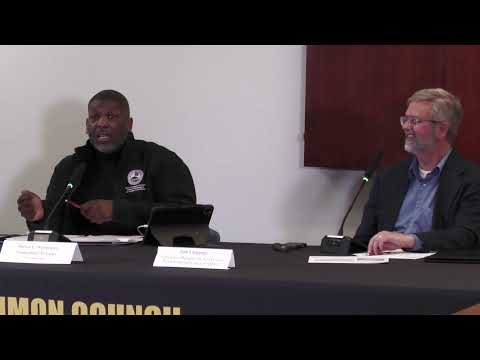
Councilman Darren Washington, the at-large member of the Gary Common Council, opened a public forum on data centers and introduced Sam Carpenter, executive director of the Hoosier Environmental Council, to brief residents on the benefits and risks of such developments.
Carpenter framed data centers as rapidly evolving, large-scale energy users that now often support artificial-intelligence workloads. “A single data center…can use the same amount of electricity as an entire city,” Carpenter said, warning of a possible doubling of statewide demand tied to AI. He also cautioned that speculative financing among AI firms could leave local communities with stranded assets if projects fail.
Why it matters: speakers said state tax and regulatory changes shift costs and risks to cities. Carpenter pointed to a 2019 state sales-tax exemption on data-center electricity and equipment (expanded in 2025) and a change in property-tax depreciation rules he attributed to “Senate Bill One,” arguing those measures can erode municipal revenue. Carpenter estimated a 100-megawatt data center would have paid roughly $3.5–$5 million annually in sales tax on electricity without exemptions.
Residents pressed for local protections, transparency and limits. A representative of Gary Advocates for Responsible Development recommended a one-year moratorium on data-center consideration so the city can craft ordinances and study impacts. “We have too many unanswered questions, financial and environmental red flags,” the speaker said during public comment.
Public-health and environmental concerns featured prominently. Several commenters and Carpenter raised PFAS (per- and polyfluoroalkyl substances) used in some cooling systems. When asked whether PFAS are poisonous, Carpenter replied bluntly: “Are they poison? Yes, they are,” and noted the U.S. Environmental Protection Agency has regulated only a limited set of PFAS compounds to date.
Carpenter recommended concrete local rules: require early and public engagement, avoid NDAs that limit disclosure, adopt data-center–specific zoning, require environmental-impact and sound studies, mandate disclosure of cooling systems and chemical additives, lock developers into paying infrastructure and decommissioning costs, and secure enforceable community-benefit agreements for local hiring and services.
Speakers also discussed who should pay for new electric generation and transmission tied to data centers. Carpenter cited state legislation (House Enrolled Act 1007) that requires large energy customers to pay 80% of new-generation costs but said loopholes exist and communities should seek guarantees that developers cover upgrades. He noted a later law (House Enrolled Act 1210) that directs 1% of certain electricity/equipment sales to local communities, which Carpenter said could produce substantial local revenue if broadly applied.
Case studies and local experience informed many comments. Ashley Williams, executive director of Just Transition Northwest Indiana, described Michigan City’s experience — citing 24/7 disruption, NDAs, uncertain remediation on a brownfield site and weak local benefits — as a cautionary example. Lisa Valley, organizing director for the same group, warned that dewatering at Hobart has moved contaminated groundwater and urged Gary to prepare if similar projects arise.
Speakers urged prioritizing scarce utilities for long-term local employers. A retired steel-worker commenter told the council to prioritize upgrades for industries that provide sustained local employment, arguing data centers create many construction jobs but comparatively few permanent positions.
Next steps: Councilman Washington said the administration has not submitted any data-center proposals to the council yet but that the council will pass on community input and is considering drafting a resolution and discussing ordinances. He encouraged residents to contact state legislators and announced a related public forum by Citizens Action Coalition.
No formal motions or votes were taken at the forum. The session concluded with the council and attendees agreeing to continue community engagement and to investigate ordinance options before any local approvals.
Sources and attribution: Quotes and claims in this article are drawn from remarks recorded at the Gary Common Council public forum on data centers, including statements by Councilman Darren Washington; Sam Carpenter, executive director of the Hoosier Environmental Council; Ashley Williams and Lisa Valley of Just Transition Northwest Indiana; and multiple Gary residents and community advocates.