Get Full Government Meeting Transcripts, Videos, & Alerts Forever!
Get email alerts on the Tribal Mou Scotts Valley topic
No spam. Unsubscribe anytime.
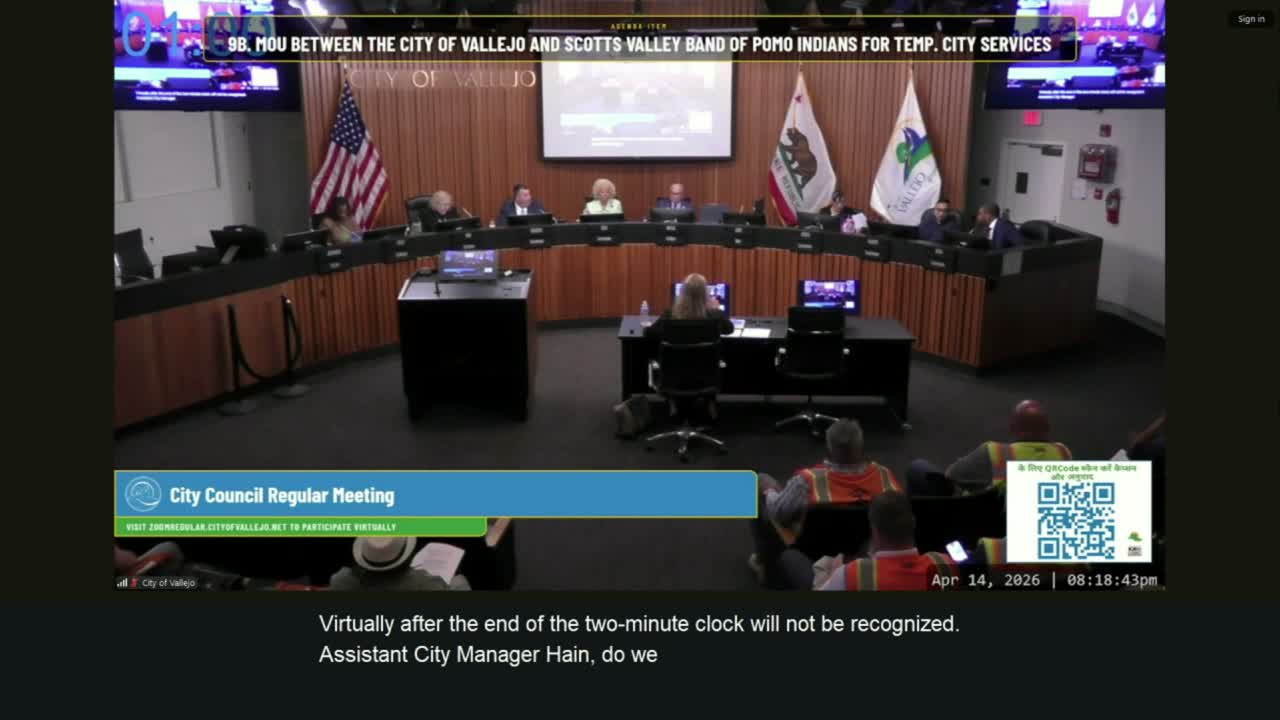
Vallejo council approves amended MOU with Scotts Valley Band of Pomo Indians after hours of public comment and new safeguards
Summary
After more than three hours of public comment and lengthy council debate, Vallejo approved a temporary memorandum of understanding with the Scotts Valley Band of Pomo Indians for municipal services to two modular tribal buildings and limited gaming, adding new conditions for community engagement, local hiring and community-benefit oversight.
The Vallejo City Council on Wednesday voted to approve an amended memorandum of understanding (MOU) with the Scotts Valley Band of Pomo Indians to provide temporary city services — police, fire and water — for modular tribal offices and a small temporary gaming operation on trust land near Columbus Parkway and I‑80.
Assistant City Manager Gillian Hain told the council the arrangement is limited to temporary services for a maximum of three years and does not approve any larger casino project. "This MOU is only a temporary service provision," Hain said during the presentation, adding staff would monitor service needs every 90 days and reserves the right to renegotiate or terminate the MOU if costs exceed projections.
Why it mattered: The proposed MOU prompted one of the largest public-comment turnouts in recent Vallejo meetings, with dozens of speakers representing tribal leaders, union members, neighborhood residents and other local stakeholders. Supporters emphasized jobs and economic opportunity; opponents — including other regional tribes and their outside counsel — urged caution given ongoing federal review and litigation over the land's gaming eligibility.
What staff told the council: Hain summarized a decade-long sequence of events that culminated in the current MOU proposal, including the Department of the Interior's January 10, 2025 decision putting the land into trust and later litigation and DOI reconsideration. Staff contrasted two public-safety impact reports: a city-commissioned peer review (AP Triton) that recommended mitigations of roughly $700,000 in year one and about $500,000 annually thereafter, and the tribe's consultant report, which estimated about $80,000 in mitigations. To bridge the gap, Hain said the tribe agreed to an activation/mobilization fee of $100,000 in year one; to pay a fully loaded police officer salary (staff described that figure as roughly $362,000 per year); to pay commercial water rates; and to provide $100,000 per year to Vallejo nonprofits with council input. "These above mitigations would be paid upon execution of the MOU," Hain said, and staff estimated a first‑year total of about $602,000 and approximately $502,000 in years two and three.
Public comment highlights: Tribal leaders including Sean Davis (Scotts Valley chairman) and Jesse Gonzalez (vice chair) framed the agreement as an urgent step toward economic stability and a return of tribal members to a homeland. Union speakers and local business advocates urged approval for jobs and construction opportunity. Other tribes, their counsel, and dozens of Vallejo residents urged postponement until the Department of the Interior completes a pending reconsideration of the tribe’s gaming eligibility and until the city conducts additional community outreach and legal review. Phil Recht, outside counsel for a nearby tribe, told the council the MOU presented legal risks and urged delay: "We suggest... best not to go forward with an MOU that has many, many legal flaws," he said.
Council debate and amendments: Councilmembers split over the timing and terms. Several members pressed for stronger protections — guaranteed renegotiation mechanisms if impacts grow, clearer escalation of mitigation payments tied to activity, and robust neighborhood engagement in District 1 where the site sits. In response, the council approved an amendment requiring: (1) explicit community engagement at every step of implementation and council review of how community‑benefit funds are allocated; (2) a 15% local‑hire target for early construction staffing with an expectation that the target scale with project staffing levels; (3) the $100,000 annual community‑benefit allocation to be coordinated with council input; and (4) a contribution from the tribe toward White Slough cleanup (amount to be negotiated).
What the vote did (procedure and limits): The council adopted a resolution approving the temporary MOU and finding the action exempt from CEQA under the limited categorical exemptions cited in the report, subject to the amendments above and to ongoing monitoring. The transcript documents the passage of the amended motion; specific roll‑call tallies for the final MOU vote are not recorded in the provided transcript excerpt. City staff said encroachment permit plans had been submitted and fees collected but were being held pending council direction.
Next steps and safeguards: Staff will continue impact analyses for long‑term project elements (traffic, water, sewer, housing/economic studies) funded by the tribe and will return to council for any intergovernmental agreement or negotiations related to a larger permanent development. The MOU includes periodic 90‑day monitoring with an option for the city to renegotiate or terminate if costs or impacts exceed expectations.
Why this remains unresolved: The federal Department of the Interior is reconsidering the tribe’s gaming‑eligibility determination, and several lawsuits remain stayed while the DOI proceeds. Multiple tribal governments in the region argued the city should await the DOI outcome to avoid creating evidence the federal process might consider. City staff and some council members said working through an MOU for temporary services is the best way to secure cost recovery and community mitigations now while preserving the ability to pause or terminate if necessary.
What to watch next: Staff indicated longer‑range traffic, economic and public‑safety analyses would continue and be returned to council as they are completed (city‑commissioned scopes indicate 3–6 months for additional economic work). Council directed staff to continue engagement with the tribe and the community, and to bring specific community‑benefit allocation proposals and any request for White Slough funding back to the council for decision.