Get Full Government Meeting Transcripts, Videos, & Alerts Forever!
Get email alerts on the Flood Grant topic
No spam. Unsubscribe anytime.
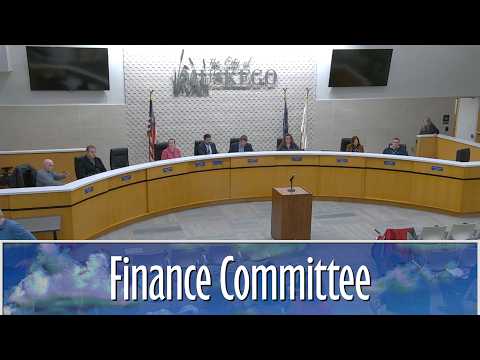
Finance committee authorizes application for DNR flood-control grant to help homeowner in floodway
Summary
Muskego City finance committee approved staff authorization to apply for a Wisconsin DNR municipal flood-control grant to assist a homeowner whose house sits in the floodway; the grant is 50% matching and the application window closes March 16.
Muskego City’s finance committee on March 10 voted to authorize staff to apply for a Wisconsin Department of Natural Resources municipal flood-control grant intended to help a homeowner whose house is located in the floodway and exceeds FEMA/DNR repair‑cost limits.
Staff member Adam told the committee that the DNR program issues grants to municipalities rather than individual homeowners and that the award would be a 50% matching grant. He said the application window closes Monday, March 16 at 4 p.m., and that staff are working to complete an appraisal the grant requires. "We have nothing to lose by trying," Adam said as he described the expedited effort to gather paperwork and appraisal documentation.
Why it matters: a property located in the floodway faces strict limits under FEMA and DNR rules on the amount that can be spent to repair a structure. Staff said the homeowner’s projected repair costs exceed those limits, making a full repair infeasible under current rules and leaving elevation or a buyout as options.
What staff told the committee: Adam said two options were presented after consulting with DNR staff: the homeowner could seek to elevate the structure high enough to meet DNR/FEMA elevation-clearance requirements (staff estimated an elevation of roughly 3–4 feet would be necessary), or the city could pursue a DNR-funded buyout and convert the parcel to permanent open space. He said the grant is competitive and that an appraisal must be performed by a state‑licensed residential or general appraiser and must be commissioned by the city ("It cannot be commissioned by the property owner," Adam said).
Costs and matching: Adam said the DNR grant would cover 50% of eligible costs; the remaining 50% must come from other sources, including potential insurance proceeds or in‑kind city services. Staff said city departments such as public works and utilities could provide in‑kind work—removing structures and clearing the site—that would count toward the required local match.
Council step and timeline: staff said the resolution required by the DNR is a standard form and will appear on the council agenda for formal approval if council agrees to submit the application. Staff cautioned that appraisals and final numbers may not arrive before the DNR deadline, but that the city is moving quickly to complete the application.
Discussion and vote: Alderman Trader asked whether the appraisal must come from a lender or realtor; staff replied that the appraisal must be by a state‑licensed residential or general appraiser and must be commissioned by the city. Alder person Wolf noted the city has pursued similar buyouts in the past and that converted properties became passive parkland. After discussion, the committee approved staff’s request by voice vote.
What happens next: staff will continue to pursue the appraisal and submit the municipal application if the council signs the required DNR resolution. The grant application decision and any subsequent council action were not recorded in the meeting; city staff said award of the grant is not guaranteed.