Get Full Government Meeting Transcripts, Videos, & Alerts Forever!
Get email alerts on the Police Policy Adoption topic
No spam. Unsubscribe anytime.
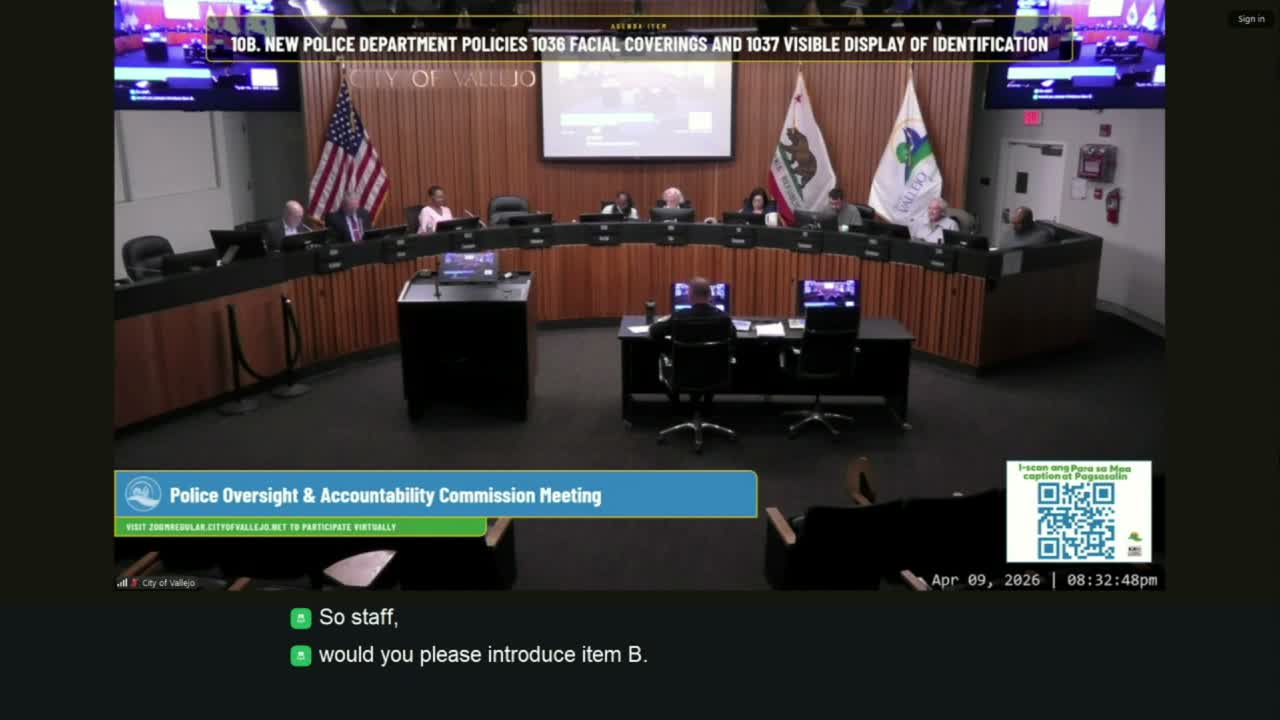
Vallejo oversight commission recommends facial-covering policy and adopts visual identification policy for VPD
Summary
POAC voted unanimously to recommend a new VPD facial-covering policy and to adopt a visible identification policy requiring agency name and a badge number or name, with limited exceptions; commissioners pressed staff on exceptions, public transparency and enforcement consequences.
The Vallejo Police Oversight and Accountability Commission on April 9 recommended that the Vallejo Police Department adopt a new facial-covering policy and adopted a visible identification policy that requires officers to display agency identification and either a name or badge number when performing enforcement duties.
Deputy Chief Knight said the proposed policies were drafted in response to recent state legislation and Lexipol27s standard policy language and that the department already uses name tags, agency patches and badge numbers in most on-duty uniforms. “In our case, we already require the name of the agency on our patches, our badge that has that has a number and a name tag,” Knight said.
Public commenters urged that officers be fully identifiable during public contact. A member of the public said visual identification is a long-established best practice and urged that officers be identifiable by badge number and name. Another commenter said the policies should be explicit and visible to the public.
Commissioners asked about exceptions (for example, tactical situations, sworn undercover operations or when officers use respiratory protection such as N95 masks for occupational safety). Staff answered that the facial-covering policy allows breathing apparatus or N95 masks where occupational health or safety requires them and that supervisors would document any exemption decisions. Commissioners also asked how violations would be handled; staff said discipline would follow existing standards-of-conduct procedures and corrective-action guidelines and could range from counseling up to progressive discipline depending on circumstances.
The facial-covering recommendation and the visual-identification resolution passed unanimously.
What27s next: Staff will finalize the resolution language and transmit the commission27s recommendation to the chief; both policies must be posted on the department website in accordance with state deadlines.