Get Full Government Meeting Transcripts, Videos, & Alerts Forever!
Get email alerts on the Criminal Justice Suppression topic
No spam. Unsubscribe anytime.
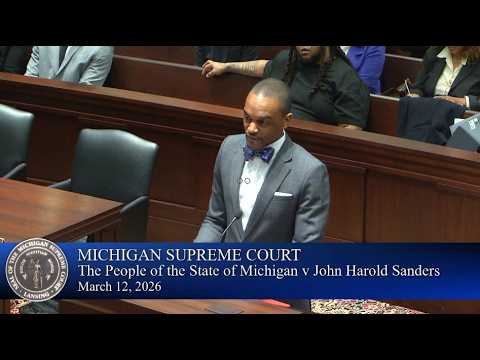
Michigan high court hears challenge over suppression of John Sanders’s confession
Summary
At oral argument, defense and an Innocence Project amicus urged the court to adopt a per se exclusionary rule for statements elicited after unconstitutionally prolonged pre-arraignment detention; the county prosecutor urged continued use of the Cypriano voluntariness test. The case was submitted for decision.
The Michigan Supreme Court heard oral arguments in People v. John Sanders, a case testing whether statements obtained during detention that violated the Fourth Amendment must be suppressed as a matter of law or instead reviewed under the longstanding Cypriano voluntariness framework.
Defense counsel Takuram Fukuza Yam Fukuzza told the court that statements made while a person is detained in violation of the Fourth Amendment "must be suppressed unless the government can establish that there were unavoidable circumstances that break the causal connection between the unreasonable pre-arraignment delay and the statements." He urged the court to overrule Manning and adopt a rule aligned with Riverside that would exclude statements unless the state proves a bona fide emergency, arguing the Lancing Police Department delayed arraignment to obtain autopsy results and used interrogation tactics that exploited Mr. Sanders’s vulnerabilities.
Lauren Goddessman, appearing for the Innocence Project as amicus curiae, urged the court to recognize decades of scientific research showing that prolonged isolation and sleep deprivation increase the risk of false confessions. "When someone is detained over multiple nights ... sleep deprivation ... renders an innocent person more vulnerable in the interrogation room," she said, arguing Michigan law should treat confessions elicited during unconstitutionally prolonged pre-arraignment detention as inadmissible to deter high‑risk conduct.
County prosecutor Elizabeth Allen countered that the appropriate inquiry is voluntariness under People v. Cypriano, a totality‑of‑the‑circumstances test that considers delay, why the delay occurred, and its effect on the accused. Allen said the Fourth Amendment timing violation here did not erase the probable cause that supported Mr. Sanders’s arrest and that suppressing a voluntary statement would undermine truth‑seeking. She invited the court to review the interrogation video and said the trial court correctly applied Cypriano in finding the statement voluntary.
Justices' questioning probed the practical consequences of each approach. Several justices pressed counsel on whether adopting a per se exclusionary rule would leave police without effective investigative tools in traumatic cases and whether Cypriano can be adapted to account for modern scientific findings about coercive interrogation tactics. Counsel and the amicus agreed that investigators still have trauma‑informed, evidence‑based interviewing techniques available; they differed over whether judicially recognizing a categorical exclusion is necessary to deter unconstitutional delay.
Both sides acknowledged the underlying Fourth Amendment issue: the United States Supreme Court’s 48‑hour rule for pre‑arraignment judicial determinations, absent a bona fide emergency. Defense counsel said the government conceded it could not show such an emergency here and reiterated that the trial court had found misleading expert testimony and due‑process violations. The prosecution acknowledged a timing violation but emphasized county courts’ ability to weigh evolving factors under Cypriano.
The court gave counsel brief rebuttal time; defense reiterated the request for a rule that would exclude statements taken after unconstitutionally prolonged detention and noted minimization tactics allegedly visible on the interrogation video. After rebuttal the case was submitted to the court for decision.
The issue before the justices is whether Michigan should (1) apply Riverside‑style exclusionary principles that treat confessions elicited during unconstitutionally prolonged detention as presumptively inadmissible absent an emergency, or (2) continue to apply Cypriano’s totality‑of‑the‑circumstances voluntariness test, incorporating modern research about false confessions. The court’s decision could affect how trial courts evaluate confessions obtained after delayed arraignment and shape training and practices for police interviews in Michigan.
The case was submitted to the court; no decision was announced at argument.