Get Full Government Meeting Transcripts, Videos, & Alerts Forever!
Get email alerts on the School Funding topic
No spam. Unsubscribe anytime.
Riverside Local weighs levy, deep cuts and Buckeye school plans to close a projected $4.5 million gap
Summary
At a March work session the Riverside Local Board discussed cost‑containment options and timelines for asking voters to raise revenue, examined income‑tax and bond financing for a planned Buckeye school project, and scheduled a deeper work session on March 26.
The Riverside Local Board of Education spent its March meeting focused on how to close a projected multi‑million‑dollar deficit and whether to put a revenue measure before voters this year.
Administrators opened a work session reviewing policy 6234 and the legal deadlines the district must meet to appear on an election ballot. Board members were told the district could face a midterm funding shortfall that staff have modeled between roughly $4 million and $4.5 million over a multiyear horizon. The administration laid out a near‑term calendar: roughly 90 days’ and 100 days’ filing windows apply depending on whether the board seeks a property‑tax or earned‑income‑tax levy, and an August filing deadline would be nonnegotiable if the district targets the November ballot.
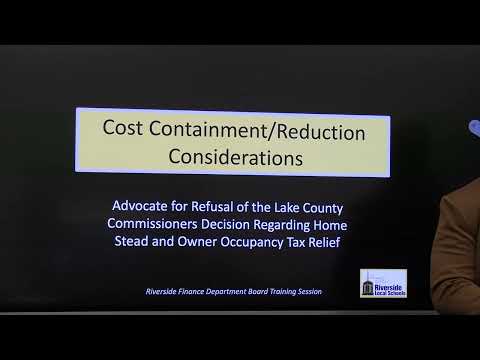
At the center of the discussion was a recent state tax change the administration said accelerated the district’s deficit. “That puts us — it’s approximately 1.66 million a year that we were told and we didn’t plan for,” the presenter stated, describing the combined homestead and owner‑occupancy adjustments that reduced district receipts. Staff outlined an array of cost‑containment ideas: revising contract language, studying retirement‑incentive programs (noting any incentive would require bargaining), auditing and consolidating software subscriptions, seeking sponsorships and banner advertising to offset graduation expenses (the district estimated graduation costs at about $40,000), and reexamining transportation routing and contract language such as bus undercoating clauses.
Board members stressed the limits of “low‑hanging fruit.” One trustee argued that modest operational savings would not close the projected gap and emphasized the need to focus on a revenue plan so the district does not enter extended deficit spending. The board approved a motion to schedule a follow‑up working session on March 26 to prioritize next steps and to form a levy committee.
How to pay for facilities also drew wide attention. District staff presented models for the Buckeye replacement/addition. Among the funding options discussed was an earned income tax to support lease‑purchase financing (sometimes presented as certificates of participation or COPs). Administration explained Ohio’s treatment of COPs and said a 1% earned‑income tax was modeled to produce roughly $13 million–$14 million annually and could be securitized to borrow for construction; they also presented lower‑cost and higher‑cost building scenarios (the transcript discussed designs ranging from about $107 million to prior estimates near $162 million, depending on scope and options). Officials noted that an income tax grows with wage inflation while property‑tax levies are constrained by House Bill 920 rules.
Board members asked for more analysis before settling on a funding path. The board did not vote on a levy question at the meeting but set the March 26 work session to refine priorities, examine the Buckeye schematic estimates and schedule public engagement. The board also heard presentations on operational efficiency targets and enrollment projections that showed how a large housing development in the district (referred to in staff material as “Casement,” roughly 1,358 homes in planning) could materially alter revenue forecasts if built and occupied at projected rates.
Next steps: the board scheduled the March 26 work session to vet priorities, directed staff to produce a short list of the highest‑impact savings and revenue options, and asked for clearer projections tying proposed changes to multi‑year budget scenarios.