Get Full Government Meeting Transcripts, Videos, & Alerts Forever!
Get email alerts on the Equity And Inclusion topic
No spam. Unsubscribe anytime.
Modesto City Schools rolls out Equity Phase 2; trustees debate definitions, evidence and scope
Summary
District staff presented 'Equity Phase 2' emphasizing implicit‑bias and trauma‑informed training, student leadership frameworks and integration into classroom practice; trustees probed measures, equity audit methods and whether long‑standing equity efforts have produced improved outcomes.
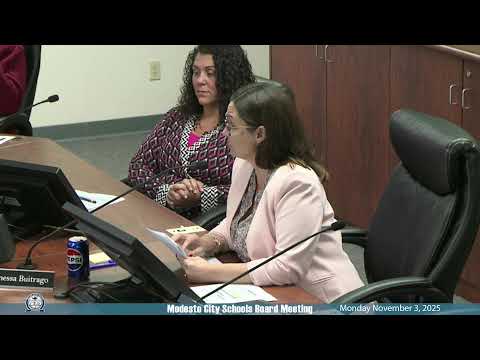
Modesto City Schools staff on Tuesday outlined a districtwide Equity Phase 2 initiative focused on expanding implicit‑bias training, trauma‑informed and classroom‑management supports, and integrating student leadership frameworks into instruction, while trustees questioned definitions, evidence of impact and next steps.
Will Patterson, the district’s equity and intervention specialist, and Ernesto Calderon, senior director of school leadership, said the Phase 2 effort grew from focus groups with administrators, classified staff, certificated staff and students that surfaced three primary needs: ongoing implicit‑bias training, additional behavioral and trauma‑informed practices, and more classroom‑management supports. The presenters said the work will be embedded through three complementary frameworks the district calls Map Your Mission (student agency), Be the Change (student leadership on school culture) and an instructional core focused on culturally responsive instruction and restorative approaches.
Patterson described the approach as data‑driven: equity audits will identify groups of students who are not meeting desired outcomes, examine access and placement, and recommend site‑level actions. He cited prior district work that the presentation said has included adopting an ethnic studies course, modifying graduation requirements for some students, and steady increases in workforce diversity.
Several trustees probed the proposal and pressed for clarity. Trustee Daly questioned whether decades of early‑childhood and equity programming have improved outcomes and urged more community collaboration. Daly said research he referenced shows mixed or declining behavioral and academic trends and argued the district should examine other community‑based approaches as part of its strategy. "I would like to see us concentrate on collaborating as a community to address these challenges rather than assign blames," Daly said.
Superintendent Dr. Petrago and staff responded that equity audits are intended to be precise: they examine enrollment and outcome data (for example, representation in Gifted and Talented programming) and drive specific, site‑based changes — the presenters gave an example of creating site‑based Gifted and Talented offerings after families reported travel barriers. Dr. Petrago said equity work spans multiple district goals and emphasized the district’s obligation to act when data show groups of students underperforming.
No formal board action was required; the item was an informational presentation and trustees asked for continued reporting and metrics. Presenters said next steps include scaling trainings, sustaining staff listening sessions and embedding equity work across the instructional core so it remains part of routine practice rather than a separate initiative.