Get Full Government Meeting Transcripts, Videos, & Alerts Forever!
Get email alerts on the Land Use Data Centers topic
No spam. Unsubscribe anytime.
Story County board trims proposed zoning language to remove data‑center and cryptocurrency uses, sets final vote
Summary
The Story County Board of Supervisors approved rescission of an earlier ordinance subject to a court injunction and on second consideration cleared a revised zoning text that removes references to data centers and cryptocurrency operations; a final reading is set for March 17 after public questions about a possible moratorium and stormwater authority.
The Story County Board of Supervisors on March 10 voted to rescind a previous ordinance and advanced a revised land‑use text that removes references to digital‑asset mining, cryptocurrency operations and data‑processing centers from the county zoning code.
Planning and development director Leanne Harter told the board the first action — Ordinance 329 — is a formal rescission of Ordinance 311, adopted in May 2023, because a permanent injunction currently prevents enforcement of that earlier regulation. "This is the action we need to take because the county is subject to a permanent injunction that prohibits enforcement of Ordinance 311," Harter said.
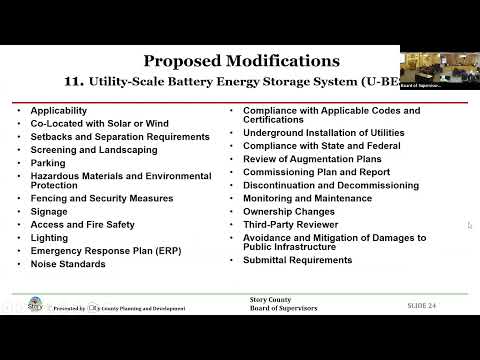
Harter then reviewed text amendment 26‑0000002 (before the board as Ordinance 330) and said the latest draft removes all uses related to digital asset mining, cryptocurrency operations and data processing centers, and deletes related parking and loading standards. She said the planning and zoning commission recommended approval and staff proposed the board not waive a third reading because of public interest.
Members of the public asked questions during the hearing. Peter Beechler asked whether planning would return to the board with a request to enact or extend a temporary moratorium on data‑center projects before a March 31 expiration, what specific policy changes supervisors were considering, and when legal counsel’s opinion on moratoria would be provided. "Will the planning and development department come back to the board of supervisors with a request to enact or extend a new temporary moratorium on data center projects prior to the March 31st expiration? If so, when will that request be made and how long will that moratorium last?" Beechler asked.
The chair responded that the issue will be considered before March 31, that legal counsel has been consulted but no timeline for a written opinion was given, and that staff could prepare a public‑facing summary of options. "Legal counsel has been consulted on this and I can't give a timeline as to when we will have that information back, but it will be considered," the chair said.
Other public commenters raised environmental and policy concerns. Steve Lequa asked whether post‑construction stormwater runoff from a large data center would be addressed by county standards; Harter said recent state legislation limits local authority on that point. "The state legislature a couple years ago passed legislation that does not allow counties and cities to regulate post‑construction storm water runoff," Harter said, noting that limitation constrains the county’s options.
Susie Petra cited reporting about state and local moratoria elsewhere in the U.S., noting that several states and municipalities have introduced or enacted temporary bans on data‑center projects in the past year.
After public comment and staff responses the board moved, seconded and approved Ordinance 330 on second consideration and set third and final consideration for March 17. The board also adopted Ordinance 329 rescinding the prior ordinance, which planners said was necessary because of the injunction.
What’s next: the board will take up the revised zoning language for a final vote on March 17 and may receive additional briefing from county legal counsel and staff information about possible moratorium options and public communications before then.