Get Full Government Meeting Transcripts, Videos, & Alerts Forever!
Get email alerts on the Small Business Finance topic
No spam. Unsubscribe anytime.
Tamara Dolving outlines steps for Hennepin County small businesses to stabilize finances during a crisis
Summary
In a presentation for Hennepin County businesses, CPA Tamara Dolving advised owners to "take a beat," prioritize safety and payroll, document damages, secure assets and use local supports such as Elevate Hennepin for no‑cost advising and navigation.
Tamara Dolving, a certified public accountant and presenter with Small Business Dream Builders, told Hennepin County business owners that the first step in a crisis is to "take a beat, pause" and aim to "respond" rather than immediately react. She framed calm assessment and planning as essential to preserve operations and staff safety.
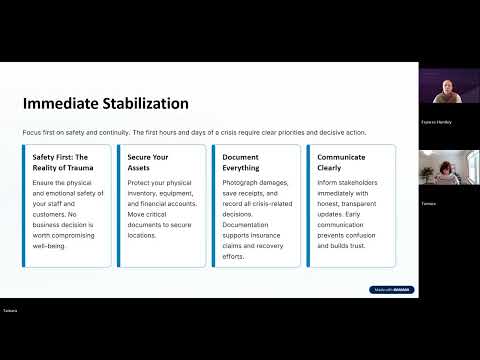
Dolving said immediate stabilization requires focusing on "safety and continuity," including the physical and emotional safety of staff and customers. "No business decision, no amount of money is worth sacrificing someone's well-being," she said, urging owners to consider temporary closures when necessary to protect employees.
A central financial point in the presentation was the importance of liquidity: "Cash flow is oxygen," Dolving said, advising owners to inventory bank accounts, savings and available lines of credit so they know how much runway they have. She recommended listing essential expenses, deciding which bills must be paid now and which can be delayed, and using that analysis to negotiate proactively with landlords, lenders and vendors.
Dolving emphasized payroll as a top priority and warned against deferring payroll taxes. "When you do payroll, don't just write your staff net checks and plan to pay the taxes later. Do not do that," she said, adding that payroll‑tax problems can create a new, separate crisis.
On recordkeeping, she recommended securing critical documents and backups (for example, saved as PDFs in cloud storage), photographing damages, saving receipts and documenting crisis‑related decisions to support insurance claims, recovery efforts and grant applications.
Communications were another practical focus. Dolving urged early, honest updates to employees, customers and partners to prevent confusion and build trust—simple steps such as signs on doors, website notices and social posts when services change. She noted that customers sometimes organize support efforts such as crowdfunding when they understand a business's situation.
Dolving also encouraged businesses to use the crisis as an opportunity to build redundancy—multiple suppliers, cross‑trained staff and additional revenue streams—and to develop and regularly update a crisis plan so responses evolve with changing conditions.
She closed by highlighting Elevate Hennepin, a Hennepin County business support initiative partnered with Small Business Dream Builders. Dolving described Elevate Hennepin's no‑cost one-on-one advising, cohort programs, business navigators and connections to HR, legal and IT resources, and encouraged eligible businesses to contact a business navigator to explore available supports.
The presentation ended with a final invitation to access Elevate Hennepin resources and no-cost advising; no formal votes or policy actions were taken during the session.