Get Full Government Meeting Transcripts, Videos, & Alerts Forever!
Get email alerts on the Public Health topic
No spam. Unsubscribe anytime.
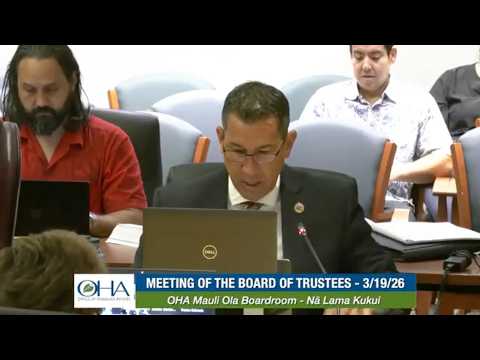
American Cancer Society pitches Health Equity Ambassador program to OHA to reduce Native Hawaiian cancer disparities
Summary
The American Cancer Society told the Office of Hawaiian Affairs board March 19 that a Health Equity Ambassador program — training trusted local messengers and coordinating supports such as Hope Lodge lodging and flights to treatment — can help address higher cancer mortality among Native Hawaiians.
The American Cancer Society on March 19 asked the Office of Hawaiian Affairs board to partner on a Health Equity Ambassador program aimed at reducing cancer disparities in Native Hawaiian communities by training trusted local messengers and coordinating patient supports.
The presentation, led by Laura Krider, executive director for Hawaii and Guam, and colleagues, described an outreach model that works through community-based organizations to recruit and equip local ambassadors to promote prevention, screening and timely access to care. "Our mission is to end cancer as we know it for everyone," Krider said, adding that the program emphasizes culturally grounded education and trust-building.
The presenters said the program builds on services the American Cancer Society already provides in Hawaii. Don Marie Turner, who identified herself as a survivor and Health Equity Ambassador, described the value of Hope Lodge lodging and peer support: "Without the American Cancer Society and Hope Lodge, our cancer journey could have been incredibly difficult. But because of them, we were never alone," she said. Presenters said Hope Lodge offers 20 guest rooms; since opening in 2016 it has sheltered about 5,500 guests and, they said, saved patients roughly $10 million in lodging costs.
Christina Martell, strategic director for diversity, equity and inclusion, said the Health Equity Ambassador program has national reach: since 2021 the initiative has touched about 1.1 million people and trained roughly 7,000 ambassadors; the presenters said a recent indigenous-community launch trained about 100 ambassadors last November. Jason Huray, director of health equity, community outreach and engagement, said the model relies on community-based organizations to ensure materials and training are locally grounded.
Trustees focused questions on access for neighbor-island patients, screening resources for uninsured people, and transportation. Trustee Huna described difficulties getting timely appointments on outer islands and asked what OCS provides for travel; presenters said the society has an airline partnership to provide roundtrip flights for patients and a caregiver, including travel to the U.S. mainland when needed. Krider and colleagues emphasized a 24/7 support line and navigation services; the presenters shared the society’s contact information as 1‑800‑227‑1234 and cancer.org.
Why it matters: Trustees and staff noted Native Hawaiians have higher cancer mortality rates and face barriers including distance, cost and medical distrust. Board members said the society’s community-centered outreach and sponsorships could help OHA reach beneficiaries, and several trustees offered to help amplify program information through OHA communications and legislative contacts.
The presentation concluded without a board vote; trustees recessed and then moved on to other agenda items.