Get Full Government Meeting Transcripts, Videos, & Alerts Forever!
Get email alerts on the Sora Recapture topic
No spam. Unsubscribe anytime.
Michigan Supreme Court weighs challenge to SORA 'recapture' registration in People v. James Ellis Jr.
Summary
At oral argument, defense and the ACLU told the court Michigan's SORA recapture provision imposes retroactive, lifetime registration tied to decades-old sex offenses; prosecutors said the case is unripe and emphasized public-safety rationales and procedural remedies.
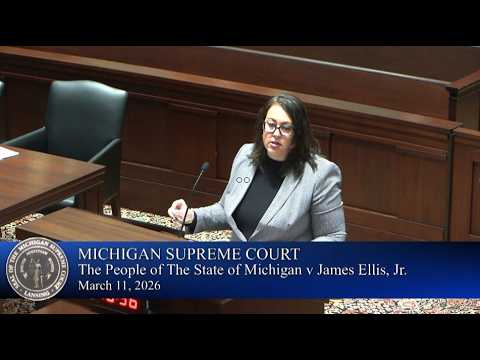
The Michigan Supreme Court heard oral argument in People v. James Ellis Jr., a constitutional challenge to a SORA recapture provision that forces lifetime sex-offender registration when a later, nonsexual felony occurs. Defense attorney Jessica Zimbleman told the justices that Ellis, who committed an attempted criminal sexual conduct in Illinois in 1983 and later pled to attempted unarmed robbery in Michigan in 2021, is being required to register for life under the recapture rule and that the statute therefore violates the Ex Post Facto Clause and, alternatively, the Eighth Amendment’s prohibition on cruel and unusual punishment.
Zimbleman said the recapture scheme ties the full extent of registration and reporting obligations to the earlier sex offense, not the later nonsexual conduct, and that the result is a retroactive increase in punishment for past conduct. “This is punishment,” she told the court, arguing the registry consequences are “tied directly to that sex offense” and leave Mr. Ellis as a Tier III registrant “for the rest of his life.” She urged the court to vacate that part of his sentence, proposing three routes: a holding that the 2021 recapture statute violates the ex post facto clause; a Lyman-based limitation that bars registration based on a nonsexual offense; or relief under Loren-factor analysis as grossly disproportionate punishment.
Marty Burgerer, appearing as amicus for the ACLU of Michigan, pressed a similar line. Burgerer told the justices the registry often lists the triggering underlying sex offense even where the later conviction is nonsexual, and he cited Landgraf and other retroactivity authorities to argue that the recapture provision effectively attaches new legal consequences to decades-old conduct.
Prosecutors replied that the case’s threshold problem is ripeness. Mark Sanford, arguing for the people, said a ruling against the state would not necessarily require Mr. Ellis to do anything different the day after this court’s decision unless he actually moved to, resided in, or temporarily stayed in Michigan: absent a concrete intent to relocate, Sanford argued, there is no present injury suitable for direct review. “If the defendant were ever to show intent to move into Michigan, he has several options,” Sanford said, listing motion practice and declaratory-judgment procedures the State said remain available.
Assistant Prosecutor Danielle Walton, representing the Prosecuting Attorneys Association, told the court that even short-term registration tied to a temporary stay would not amount to the kind of punishment required to trigger ex post facto relief in the State’s view. Walton urged the justices to adhere to the established test that focuses on whether the punitive act occurred after the statute’s effective date and cited precedent the State says supports that framing; she also emphasized the public-safety purpose of the recapture provision and pointed to risk-assessment literature discussed in briefs.
Justices pressed counsel on discrete questions: what offense is listed on SORA for recapture cases (defense and amicus said the registry lists the underlying sex offense and sometimes an "other" or code for the later offense), whether MCL 28.725(15) (the subsection the bench referenced about credit for non‑incarceration time) alters the ex post facto analysis, and how the Court should treat the statutory definition of “temporary residence.” Counsel also debated whether recapture functions like a traditional recidivist enhancement or instead channels people into the registry’s punitive scheme by reference to a prior sex conviction.
In rebuttal, Zimbleman reiterated ripeness and present-injury arguments: she said the statute’s undefined terms—such as what counts as a temporary residence—create immediate and uncertain burdens that influence life choices now. “That risk of this burdensome registration statute is impacting his life choices,” she said, noting hypothetical scenarios (for example, a medical stay) that could trigger registration duties.
The case was submitted after argument. The Court did not announce a decision from the bench.
Authorities and statutes discussed at argument include MCL 28.721a and MCL 28.725(15), and multiple cases were cited by counsel, including Lyman, Loren, Landgraf, Johnson v. Madigan, and People v. Warner. Counsel also discussed registry practice (including references to a listing code sometimes labeled “9999” to indicate an "other" offense on SORA) and risk instruments such as Static-99R as they related to public-safety arguments.
What happens next: the Court will confer and issue an opinion resolving whether, and on what grounds, the recapture provision survives constitutional scrutiny or must be struck down or narrowed.