Get Full Government Meeting Transcripts, Videos, & Alerts Forever!
Get email alerts on the Heber Valley Corridor topic
No spam. Unsubscribe anytime.
UDOT advances Heber Valley corridor preferred alternative B; local farmers and conservationists raise land‑use concerns
Summary
UDOT project staff said Alternative B is the preferred option for the Heber Valley corridor EIS because it reduces Main Street congestion through 2050; staff reported the draft EIS drew about 800 public comments and acknowledged concerns about farmland impacts and relocations.
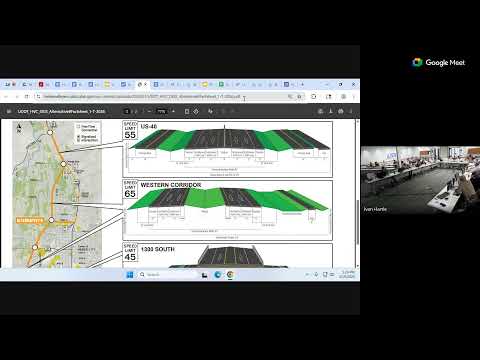
UDOT project staff presented maps and analysis from the draft environmental impact statement for the Heber Valley corridor and said the department had selected Alternative B as the staff preferred alternative because modeling shows the route better manages projected congestion through 2050.
"We selected Alternative B as our preferred alternative," project manager Craig said while displaying side‑by‑side corridor maps. He added staff received about 800 public comments during the 60‑day public comment period and that both alternatives have trade‑offs: Alternative A would use the existing US‑40 corridor and would require a larger number of property relocations, while Alternative B routes through north fields, affects agricultural lands and wetlands but would produce larger congestion relief and fewer relocations.
Craig provided relocation counts staff used in the EIS: roughly 27 relocations under Alternative A versus about eight relocations under Alternative B. He also noted environmental impacts such as wetland and farm‑land disturbance are greater under Alternative B in certain segments and that some privately held lands have conservation interest.
Commissioners and participants pressed for more detail on truck counts, potential mitigation, and options for conserving agricultural lands (including purchase of development rights). Several commissioners asked whether local agricultural stakeholders had proposed alternative alignments; staff said alternative alignments were considered in the environmental process but typically offered less congestion relief.
UDOT emphasized the Commission does not approve environmental documents — the federal/state environmental process sets the schedule and rules — and said the Commission's later role would be to decide whether to fund a department‑selected alternative after environmental decisions and permitting are complete. Staff offered to schedule an open discussion segment later in the day with the regional project team to dive deeper into alignment alternatives, mitigation strategies and potential land‑conservation funding options.