Will County launches update to Land Use Resource Management Plan; board flags farmland, data-center and infrastructure concerns
Summary
Will County’s Land Use and Development Committee met May 11 to begin a countywide update of the Land Use Resource Management Plan. Consultants outlined the project schedule and online engagement tools while board members emphasized farmland protection, water and truck-traffic infrastructure, housing options and better coordination with municipalities.
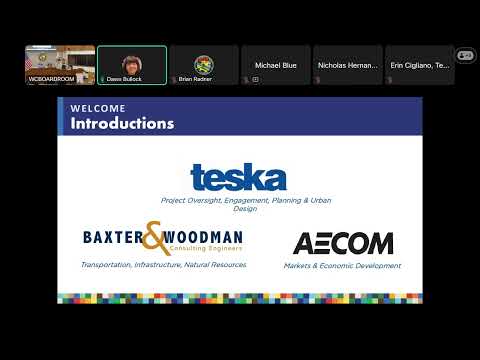
Will County Board Chair Joe Van Duyne convened a special steering-committee meeting at 10:00 a.m. May 11 to launch a countywide update of the Land Use Resource Management Plan and to begin collecting priorities from board members and staff. Consultants from Teska, AECOM and Baxter & Woodman described the project schedule, public-engagement tools and the two plan elements to be revised: the policy gateway and the forms-and-concepts handbook.
The kickoff focused on process and priorities rather than decisions. "What does success look like?" Teska Vice President Michael Blue asked the committee, urging members to think beyond immediate case-by-case issues and toward a plan that will guide legal, budgetary and implementation choices. Teska lead engagement staff Erin Sigliano said the team will conduct township stakeholder interviews, countywide open houses and two rounds of public surveys; the project website (guidewill.co) and an interactive comment map are live for early input.
Board members raised a range of concerns they want the updated plan to address. Frankie Pretzel, chairman of the Land Use Committee, said the county often reacts to new proposals and urged planning that anticipates emerging uses: "We're always seemingly reacting to things and not thinking about it proactively." Multiple members cited the rapid growth of warehousing and the emergence of data centers and large-scale solar as land uses that require proactive siting rules and infrastructure planning.
Several members focused on farmland and open-space protection. Steve Balich proposed an offset or mitigation approach similar to wetland mitigation—requiring developers who convert farmland to set aside equivalent acreage within the county—while Judy Ogalla urged the board to identify funding options for agricultural easements. Members discussed tailoring agricultural zoning to permit smaller-scale agricultural enterprises (e.g., hobby farms, artisanal producers) that have become more common.
Water and transportation infrastructure were recurring priorities. Herbert Brooks and others stressed water reliability in parts of Joliet and the need to plan utility capacity before approving major developments. Members also raised road safety and wear from heavy truck traffic tied to logistics and warehousing, and suggested better coordination with the Illinois Department of Transportation and neighboring Indiana jurisdictions to manage truck routing.
Housing and neighborhood design received attention in small-group exercises. Board members recommended expanding options such as accessory dwelling units and varied housing types for seniors, and they asked for clearer permitting checklists and outreach to help property owners navigate approvals.
Consultants committed to cataloguing municipal comprehensive plans and to mapping transition zones where development pressure is shifting. They will bring back analysis of existing conditions, infrastructure constraints and proposed policy language for committee feedback. The consultants also conducted a live, non-scientific phone poll of attendees that reinforced the priorities cited in discussion: guiding new development, protecting farmland and addressing transportation and utilities.
No formal policy or ordinance votes were taken at the session. The meeting closed after consultant remarks and small-group reports; a motion to adjourn, moved by Raquel Mitchell and seconded by Destiny Ortiz, passed by voice vote.
Next steps: consultants will complete inventories of municipal plans and existing conditions, run the scheduled public engagement activities (township interviews, open houses, surveys), and return to the steering committee with draft policy options and implementation guidance for further review.
AI generated
The text on this page is AI generated. Summaries, highlights, analysis, and video transcripts are all produced from the original source material.
AI can make mistakes, so if you spot one, and we will fix it for everyone.
Note: the source content is unaltered by us. Any content source we link to, be it a video, an audio recording, or a document, is presented exactly as its publisher released it. That publisher is usually a government body, sometimes an individual official or another organisation.